%20file.png)

Your Guide to a Winning Feasibility Study
So, you have a brilliant idea. But before you pour your heart, soul, and hard-earned capital into it, how do you know if it will actually work? That's precisely the role of a feasibility study—it's the crucial reality check that separates a winning concept from a costly misstep.
Think of it as the ultimate pre-flight inspection for your business venture. It's a deep dive into every critical aspect, from market demand to financial viability, designed to tell you one thing: is this project cleared for takeoff?
Your Project's Blueprint for Success

Picture an architect about to design a new landmark tower. Long before the first shovel hits the ground, they build a detailed model. This isn't just a pretty miniature; it's a rigorous test of the building's structural integrity, its resilience against the elements, and its place in the city's skyline. A feasibility study does the exact same thing for your business idea.
This process is your project's architectural plan, turning a back-of-the-napkin concept into a thoroughly vetted strategy. It's far more than just a document; it’s a proactive analysis that serves as your first line of defence against expensive mistakes and hidden pitfalls. By looking at your idea from every angle, you build a solid foundation on hard data, not just hopeful assumptions.
Building Confidence Through Clarity
At its core, a feasibility study is about answering one simple but profound question: Is this project worth pursuing? It challenges you to step back from your passion and face the cold, hard facts of bringing it to life. This gives you a clear-eyed perspective on potential hurdles and, crucially, often reveals unexpected opportunities you might have missed.
This structured investigation gives you the power to:
Validate Your Idea: Is there a real, paying market for what you want to offer?
Secure Funding: A data-driven case is what convinces investors and lenders to back you.
Optimise Your Strategy: You can compare different approaches and pinpoint the most effective path forward.
Mitigate Risks: See problems on the horizon and create solid contingency plans before they happen.
A feasibility study is the single most important investment you can make in your project's future. It provides the confidence to move forward boldly or the wisdom to pivot strategically, preventing the waste of invaluable resources on an unviable venture.
Ultimately, a well-executed feasibility study turns ambiguity into actionable intelligence. This is absolutely critical in fast-paced markets like the UAE and Oman, where diligent preparation is what separates the ventures that flourish from those that fail. It ensures every step you take is informed and intentional, perfectly aligning your vision with a practical roadmap to success. For a closer look at a related discipline, check out our guide to building project management skills.
The Five Pillars of Project Viability
So, you have a brilliant idea. But how do you know if it can actually stand on its own two feet in the real world? A truly robust feasibility study doesn't just ask one big, vague question. Instead, it breaks down the entire venture into five distinct, foundational supports.
Think of them as the pillars holding up your project: Technical, Financial, Market, Operational, and Legal. Each one gives you a different, crucial perspective. By looking at your idea through each of these lenses, you build a complete, 360-degree view, turning gut feelings and uncertainty into a clear, calculated path forward.
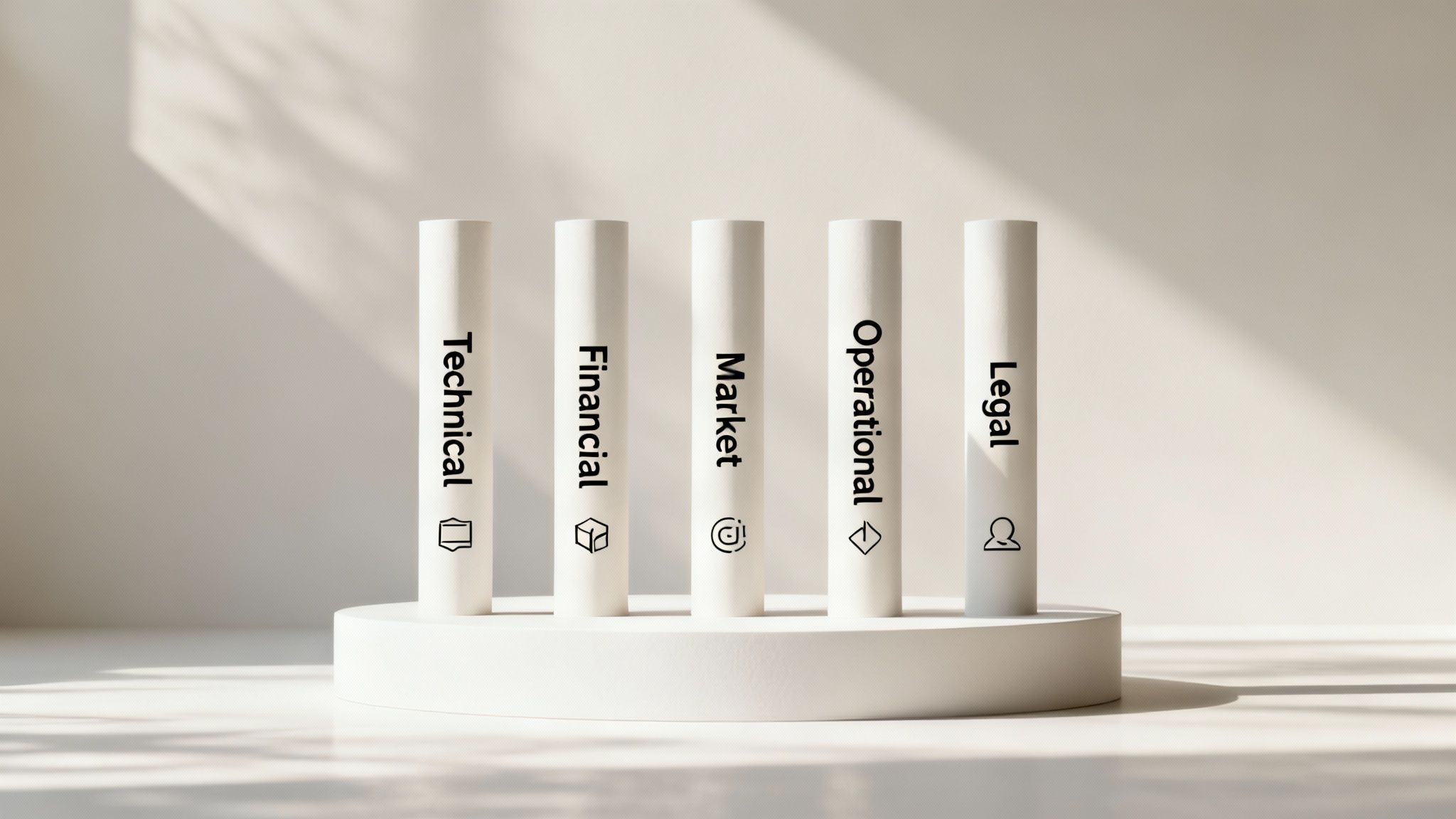
Let's break down what each of these pillars really means for your project.
1. Technical Feasibility: Can We Realistically Build It?
First things first: is your idea even possible? Technical Feasibility isn’t about whether your idea is good; it’s about whether it can be physically created. It asks a simple, brutal question: do we have the technology, the resources, and the skills to actually bring this to life?
For a software company, this might mean figuring out if their current code base can handle a new AI feature. For a manufacturer, it’s about knowing if their machines can produce a new product, or if they need to budget for a massive equipment overhaul.
A technical feasibility study is the ultimate reality check. It’s like an engineer confirming that the bridge you want to build can actually span the river—before you lay a single brick.
This analysis forces you to get specific about the hardware, software, and human expertise required. It shines a light on potential technical roadblocks early on, giving you time to plan around them or decide if the technology is just too new or too expensive to bet on right now.
2. Financial Feasibility: Will It Be Profitable?
Even the most incredible, technically perfect project is doomed if it doesn’t make financial sense. That brings us to Financial Feasibility. This pillar is all about the numbers. It’s a deep dive into the costs and benefits to answer the one question every investor will ask: will we make money?
This isn’t just back-of-the-napkin maths. It involves a few critical steps:
Estimating Total Costs: This covers everything from initial startup expenses and ongoing operational costs to marketing budgets and, crucially, a buffer for unexpected surprises.
Projecting Realistic Revenue: Using solid market data, you'll need to forecast sales and develop a smart pricing strategy.
Calculating Profitability: This is where you determine your break-even point, the potential return on investment (ROI), and how long it will take to get your initial investment back.
This is the language that banks and investors speak. It requires you to build detailed financial models and cash flow projections, often looking three to five years down the road. It’s the sober, honest assessment of whether your venture will be a financial success or a costly drain.
3. Market Feasibility: Is There a Real Demand?
Okay, so you can build it and it looks profitable on paper. But will anyone actually buy it? This is the central question of Market Feasibility. It’s time to look outside your own walls and figure out if a genuine market exists for what you’re offering.
Imagine a chef planning a new five-star restaurant. They wouldn't just pick a random spot and hope for the best. They’d study foot traffic, analyse the local demographics and income levels, and scope out every competing restaurant in the area. That’s market feasibility in action.
You have to dig deep into your target audience, understand industry trends, and get to know your competition inside and out. It’s about gauging real demand, not just wishful thinking.
4. Operational Feasibility: Can We Run It Day-to-Day?
Operational Feasibility shifts the focus back inside your company. It tackles the practicalities of running the project once it’s up and running. Can your current team, structure, and processes actually handle the day-to-day demands of this new venture?
This analysis looks at everything from staffing needs and supply chain logistics to whether your team has the bandwidth to manage new workflows. A project can be technically possible, financially sound, and have a hungry market, but if your organisation isn’t equipped to handle the operational strain, it will quickly fall apart. This is where you make sure the engine is ready for the extra horsepower.
5. Legal Feasibility: Are We Playing by the Rules?
Last but certainly not least, Legal Feasibility asks a non-negotiable question: does our project comply with all the relevant laws and regulations? Getting this wrong can lead to crippling fines, legal battles, or even a complete shutdown.
This pillar is your legal shield. It involves scrutinising everything from zoning laws and data protection regulations (like GDPR) to industry-specific licences and permits. It ensures your project is built on a solid legal foundation from the very beginning.
To tie this all together, here’s a quick overview of how these five pillars work together to provide a comprehensive analysis of your project's viability.
The Five Pillars of Feasibility Analysis | ||
|---|---|---|
Pillar | Core Question | Key Focus Areas |
Technical | Can we build it? | Technology stack, resources, hardware, software, technical expertise, scalability |
Financial | Will it be profitable? | Start-up costs, operating costs, revenue projections, ROI, break-even point, funding sources |
Market | Will people buy it? | Target audience, market size, competition, industry trends, pricing strategy, demand analysis |
Operational | Can we run it effectively? | Staffing, logistics, internal processes, management, supply chain, production capacity |
Legal | Is it compliant? | Licences, permits, zoning, data protection laws (e.g., GDPR), industry regulations, intellectual property |
By systematically addressing each of these pillars, you move from a promising idea to a thoroughly vetted, bankable business plan. It's the groundwork that separates the ventures that succeed from those that were destined to fail from the start.
A Step-by-Step Guide to Your Feasibility Study
Turning a powerful idea into a tangible success story takes more than just vision; it demands a structured, methodical journey. A feasibility study is that very process, transforming your concept from a hopeful ambition into a data-backed plan. This guide is your roadmap to navigate the study with confidence, ensuring no stone is left unturned.
Think of this process less like a rigid checklist and more like a dynamic investigation. Each step builds on the last, painting an ever-clearer picture of your project’s potential. Ultimately, it prepares you to make the most critical decision of all: whether to proceed, pivot, or pause.
Step 1: Conduct a Preliminary Analysis
Before you dive headfirst into deep research, start with a high-level assessment. This initial phase is your quick filter, designed to help you spot any obvious deal-breakers without sinking significant time and resources into a non-starter. It’s about asking the big, essential questions to get a feel for your idea's general viability.
Your goal here is simple: define the project’s core purpose and what you hope to achieve. At this stage, you should be on the lookout for any major roadblocks that could kill the project on arrival, like truly prohibitive costs or a clear lack of market need. Consider this your first, crucial reality check.
Step 2: Define the Project Scope
Once you've got a positive preliminary outlook, it’s time to draw some clear boundaries. Defining your project’s scope is one of the most critical parts of any feasibility study. It’s your best defence against "scope creep"—that all-too-common tendency for a project to balloon beyond its original goals, draining your budget and blurring your focus.
A well-defined scope should clearly spell out:
Specific Objectives: What, precisely, are you aiming to achieve?
Key Deliverables: What will be the tangible, measurable outputs of the project?
Constraints and Limitations: What are the known boundaries when it comes to budget, timeline, and resources?
Getting this clarity upfront ensures that everyone involved shares the same vision of success, keeping the entire analysis sharp, focused, and efficient.
A feasibility study without a clearly defined scope is like a ship without a rudder. It might be moving, but it has no clear direction and is likely to end up far from its intended destination.
Step 3: Perform In-Depth Market Research
Now, it’s time to look outward. Your idea might seem brilliant in a vacuum, but its success completely hinges on real-world demand. Market research is where you move beyond assumptions and ground your project in solid data about your industry, your customers, and your competition.
This means getting your hands dirty analysing the size of your target market, truly understanding customer needs, and sizing up the competitive landscape. In markets like the UAE and Oman, it also means digging into local consumer behaviour, cultural nuances, and specific regulations that could make or break your entry strategy. For a deeper look at this process in a local context, our smart project planning guide for Dubai offers some invaluable insights.
Step 4: Complete a Thorough Financial Analysis
This is where the numbers really do the talking. A comprehensive financial analysis determines if your project is actually economically sound. It’s a detailed, no-nonsense examination of all potential costs versus projected revenues to figure out its long-term profitability.
Your financial model absolutely must include:
Start-up Costs: A complete breakdown of every initial expense needed to get off the ground.
Operational Costs: All the ongoing expenses required to keep the project running.
Revenue Projections: Realistic forecasts firmly based on your market research, not wishful thinking.
Key Financial Metrics: Essential calculations like the break-even point, Return on Investment (ROI), and cash flow projections.
This analysis is the bedrock of your pitch to any investor or lender. It has to be realistic, meticulously detailed, and built on justifiable assumptions. It’s the ultimate proof that your venture isn't just a great idea, but a financially sustainable one.
Step 5: Finalise and Consolidate Your Findings
The final step is to bring everything together into a single, cohesive, and compelling report. Your feasibility study should culminate in a clear, unambiguous recommendation. All the data from your technical, market, operational, legal, and financial deep dives is consolidated here to support one final verdict.
This final document isn't just a summary; it's a strategic tool. It should tell a clear story, outlining the project's strengths, weaknesses, opportunities, and threats. Armed with this holistic view, you can finally make a confident go/no-go decision, backed by the evidence needed to either move forward decisively or pivot intelligently.
Speaking the Language of Investors
When you walk into a room with investors or lenders, you’re not just sharing an idea; you're proposing a financial partnership. They live and breathe data, risk, and return, so you absolutely must speak their language. Your passion is the engine, but a rock-solid feasibility study gives them the hard numbers they need to see your venture as a smart investment.
This means going way beyond a simple profit and loss statement. To win their confidence, you have to master the key metrics that broadcast your project's financial health and potential. These aren't just abstract calculations; they are powerful signals about the future you're building.
Decoding Key Financial Metrics
Three of the most critical metrics you'll encounter are the Net Present Value (NPV), Internal Rate of Return (IRR), and the Payback Period. Each one tells a different, crucial part of your project's financial story.
Net Present Value (NPV): This answers the big question: "What is this entire project worth in today's money?" It’s built on the principle that a dirham today is worth more than a dirham tomorrow. A positive NPV is a great sign, showing that your projected earnings, adjusted for today's value, outweigh the initial cost.
Internal Rate of Return (IRR): Think of IRR as the project's own internal growth rate. It’s the discount rate that makes the NPV of all your cash flows exactly zero. If your project's IRR is higher than your company’s required rate of return (or the cost of capital), it’s usually a green light.
Payback Period: This is the most straightforward of the bunch. It simply tells you how long it will take to get your initial investment back from the project's cash flows. Naturally, a shorter payback period feels less risky to investors.
Getting these metrics right is fundamental. To dive deeper into how a project's overall worth is determined, you can explore the different business valuation methods and techniques in our comprehensive guide.
Stress-Testing Your Financial Future
A truly great financial model doesn’t just paint a best-case-scenario picture. Investors have seen it all, and they know reality is messy. This is why sensitivity analysis is such a game-changer. It’s the process of deliberately stress-testing your numbers by changing key assumptions to see what happens.
What if your sales come in 15% lower than you hoped? Or if the cost of a key raw material spikes by 20%? By running these "what-if" scenarios, you’re not showing weakness—you’re demonstrating foresight and preparation. It proves you’ve thought about the risks and truly understand what makes your project tick.
This simple workflow shows how we move from deep analysis to the final, bankable findings that get a project over the line.

As you can see, rigorous analysis is the foundation that supports the financial projections investors care about most.
Presenting Your Case with Credibility
At the end of the day, your job is to tell a complete, transparent, and compelling financial story. Your feasibility study is the book in which that story is written. It has to be organised, clear, and ready for some serious scrutiny.
Mastering your financial metrics isn't just about passing a test; it's about building undeniable credibility. When you can confidently explain your NPV, defend your IRR, and discuss your sensitivity analysis, you transform from a hopeful entrepreneur into a credible business partner.
To share your findings professionally and navigate the intense evaluation process, using a secure platform like Data Rooms for Due Diligence is a smart move. It ensures that everyone can access sensitive information in a controlled environment. When you speak the language of investors with confidence and clarity, you dramatically increase the chances of getting the funding you need to bring your vision to life.
How Feasibility Studies Drive Real-World Impact

Financial models and theory are one thing, but the true power of a feasibility study is its ability to turn a big idea into something real. These aren't just dry academic exercises. They are the strategic blueprints behind some of the most complex and important projects happening right now across the Middle East and North Africa (MENA).
Whether it’s tackling a huge social challenge or shaping a country's economic future, smart, data-driven planning is what makes progress possible. A feasibility study is that crucial first step. It grounds a bold vision in the cold, hard realities of execution, funding, and long-term sustainability. It’s the bridge between a brilliant concept and a life-changing result.
From Social Goals to Investable Projects
Think about a challenge as enormous as integrating refugee workforces into local economies. This isn't just a business problem; it’s a deeply human and economic goal. But good intentions alone don’t create jobs or attract the investment needed to make a real difference.
This is exactly where a feasibility study proves its worth. Back in 2017, a detailed seven-month study was undertaken to design a development impact bond (DIB) that could create jobs for Syrian refugees across the Middle East. The analysis pinpointed which countries and partners were best positioned for success, giving major investors the confidence they needed to get behind the programme. You can read more on how this feasibility analysis paved the way for social impact.
A feasibility study is the engine that turns noble intentions into bankable, actionable projects. It delivers the evidence, structure, and risk analysis needed to convince stakeholders that a bold vision is not just worthwhile, but genuinely achievable.
Powering National and Corporate Ambitions
The impact doesn't stop with social initiatives. At a national level, governments rely on feasibility studies to weigh up massive infrastructure projects—from new green energy networks to weaving artificial intelligence into public services. These studies ensure that taxpayer money and sovereign wealth funds are put to work for the greatest possible economic and social good.
For businesses, these studies are the very foundation of strategic growth. Before a company commits hundreds of millions of dirhams to a new factory in a Jafza free zone or a luxury resort in Oman, a feasibility study confirms the market is there, the numbers add up, and the operational plan is solid.
The biggest success stories in our region are almost always built on a bedrock of diligent preparation. You can see how this foundational work leads to tangible results in some of our own Credence & Co. case studies.
In the end, every great project starts with a simple question: "Can we actually do this?" A feasibility study delivers the clear, evidence-based answer, giving leaders the confidence they need to invest, build, and shape the future.
Common Pitfalls and How to Avoid Them
Embarking on a feasibility study is a huge step. It’s your commitment to swapping guesswork for genuine, data-backed clarity. But even the most brilliant ideas can get derailed by common, and frankly, avoidable mistakes. Knowing these pitfalls isn’t just about dodging errors; it's about building a fortress around your project, protecting it from the hidden biases and wishful thinking that can sink a venture before it even starts.
One of the sneakiest traps is confirmation bias. We all do it. We fall in love with our own idea and then start hunting for evidence that proves we're right. It’s human nature to gravitate towards information that confirms our beliefs, but in business, it’s a killer. You start seeing all the positive market signals and conveniently ignoring the glaring red flags, creating an echo chamber that feels great but is built on a foundation of sand.
Another classic blunder is taking a superficial approach to research. A quick Google search and a few outdated industry reports just won't fly. This kind of shallow-dive analysis almost always leads to wildly optimistic revenue forecasts and laughably underestimated costs, setting your project up for a painful cash crunch right out of the gate.
Staying on the Path to Success
So, how do you avoid these traps? You have to shift your mindset from "proving my idea is great" to "discovering if this idea is viable." The goal is truth, not validation. Think of it as a genuine exploration, not a box-ticking exercise.
Here are a few battle-tested strategies to keep your analysis sharp, honest, and grounded in reality:
Embrace healthy scepticism. Actively look for reasons why your project might fail. Seriously. Assign someone on your team to be the official "devil's advocate," whose only job is to poke holes in every assumption and stress-test every piece of data.
Dig deeper than the surface. Don't just rely on secondary data. Get your hands dirty with primary research. Talk to real potential customers through surveys and focus groups. Interview your competitors. This real-world intelligence is worth its weight in gold compared to generic reports.
Build in a buffer for reality. When you’re forecasting costs and timelines, always add a contingency. Trust me, unexpected expenses will happen. Planning for them isn’t pessimism; it's a sign of a mature, realistic strategy. These principles are universal; for instance, you can see similar themes in our guide to common mistakes in property valuation here: https://www.cnco.ae/post/eight-typical-pitfalls-you-must-dodge-when-pursuing-a-property-valuation-service.
The purpose of a feasibility study is not to prove your idea is perfect. It is to discover if your idea is viable. A truly successful study is one that gives you the unvarnished truth, empowering you to proceed with confidence or pivot with wisdom.
Crafting a Winning Final Report
At the end of the day, all your hard work needs to be presented in a report that doesn't just inform but inspires confidence. A truly effective feasibility report is clear, logical, and built on a bedrock of solid, undeniable data. For those looking to go even deeper, identifying and avoiding hidden risks in complex projects offers fantastic additional perspectives from a specialised angle.
Your final deliverable absolutely must include these four things:
A Compelling Executive Summary: This is your elevator pitch. A busy investor should be able to read this one section and get a crystal-clear picture of the project's potential. Make it powerful.
A Transparent Methodology: Don't hide how you got your numbers. Clearly lay out how you gathered your data and why you analysed it the way you did. This transparency is what builds credibility and trust.
Detailed Findings: This is the heart of the report. Present the results for every pillar—market, technical, financial, operational, and legal—and back up every claim with hard evidence.
A Definitive Recommendation: Don't sit on the fence. The report must end with a clear, unambiguous "go" or "no-go" call. This isn't just an opinion; it's the logical conclusion of all the evidence you’ve painstakingly gathered.
Got Questions About Feasibility Studies? We’ve Got Answers.
When you're standing at the starting line of a new venture, questions are a good thing. They’re the first step toward building a solid foundation. We get asked a lot about the nitty-gritty of feasibility studies, so we’ve put together some straight answers to the most common queries.
Think of this as your quick guide to demystifying the process, helping you move from 'what if' to 'what's next' with total clarity.
How Long Does a Feasibility Study Take?
There’s no magic number here—it all comes down to the size and complexity of your vision.
A straightforward study for a small local business might wrap up in just a few weeks. But if you’re looking at a large-scale industrial project or planning a major market entry into a place like the UAE or Oman, you’re in for a much deeper dive. A truly thorough analysis, complete with rigorous market research and financial modelling, could easily take three to six months, and sometimes even longer.
What Is the Difference Between a Feasibility Study and a Business Plan?
This is a really important one. They might sound similar, but they play completely different roles at different times. Getting the order right is critical.
A feasibility study is your investigation. It asks the big question: "Should we even do this?" Its entire purpose is to stress-test your idea against reality to see if it’s viable before you sink major resources into it. The result is a clear go/no-go decision.
A business plan, on the other hand, is your roadmap. It answers the question: "Okay, it's a go. How are we going to make this happen?" It lays out the strategy for executing a project that has already been proven feasible. The study validates the idea; the plan brings it to life.
Should I Do the Study Myself or Hire a Consultant?
Doing some initial homework yourself is always a smart move. But when it’s time to get serious, bringing in a professional consultant is less of a cost and more of a strategic investment. Why? It boils down to three things: objectivity, expertise, and credibility.
An external expert provides a clear-eyed, unbiased view, free from the passion and potential blind spots that come with being close to a project. Consultants live and breathe this stuff—they have access to better data, sophisticated tools, and a wealth of experience from seeing what works (and what doesn't).
Perhaps most importantly, a study from a respected firm like ours carries real weight. When you walk into a meeting with investors, bankers, or regulators, a professional, third-party analysis speaks volumes. It shows you’ve done your due diligence and gives them the confidence they need to back you.
Your project deserves a foundation built on data, not assumptions. At Credence & Co., we provide the rigorous, independent analysis you need to make confident decisions and secure the backing of key stakeholders. Explore our expert valuation and advisory services today.


Comments