%20file.png)

Your Guide to Mortgages in Dubai
- Credence & Co
- Dec 3, 2025
- 16 min read
Picture this: you’re holding the keys to your dream home in Dubai. That vision feels closer than ever, doesn't it? Securing one of the many mortgages in Dubai isn't just about financing a property—it's your most powerful tool for building a future and a legacy in this incredible city. Whether you're a resident or an international investor, this guide will turn a complex process into a clear, confident journey.
Your Journey to Dubai Property Ownership

Stepping into the Dubai property market is an electrifying experience. Getting a mortgage is so much more than a financial transaction; it’s the very foundation that turns your ambition into a tangible reality. Think of it as an investment in a lifestyle and a stake in one of the world's most dynamic real estate landscapes.
This guide is your roadmap. We’ll navigate every turn together, demystifying the world of mortgages in Dubai and giving you the clarity and confidence to move forward. The path ahead might seem detailed, but every step is a logical move toward your ultimate goal.
What This Guide Will Cover
We believe in being prepared. Think of this guide as your personal property finance mentor, here to help you understand every critical piece of the mortgage puzzle. Our mission is to give you the complete picture, so there are absolutely no surprises along the way.
Here’s a sneak peek at what we'll explore together:
The Market Landscape: Get to know the key players and what makes Dubai's property finance sector unique.
Eligibility Decoded: We’ll break down exactly what lenders are looking for in both residents and non-resident applicants.
Choosing Your Loan: Discover the different types of mortgages to find the one that fits your financial strategy perfectly.
Application Blueprint: A step-by-step walkthrough of the entire process, from getting pre-approved to the final handover.
A mortgage is more than a loan; it’s the bridge between dreaming of a home in Dubai and actually owning it. When you see it as a strategic tool, not just a liability, you’ve already taken the first step toward a brilliant property investment.
A Practical Path Forward
This guide is built on practical, real-world knowledge and advice you can act on today. We cut through the theory to give you the insights needed to make smart, informed decisions. For a wider view, our detailed article on how to buy property in Dubai provides a practical guide that perfectly complements this mortgage journey.
Let’s begin this exciting chapter together and turn your vision of a Dubai home into a reality.
Understanding the Dubai Mortgage Landscape
To get the best mortgage in Dubai, you first need to understand the field you're playing on. Think of Dubai's property finance world as its own bustling metropolis – full of opportunity, but with its own unique rules of the road. It's a dynamic landscape shaped by huge global banks, specialised local lenders, and a market rhythm you just won't find anywhere else.
Let me put it this way: in many parts of the world, mortgages are the main fuel for the property market. In Dubai, the engine runs on a different mix. The mortgage sector here is strong and growing, absolutely. But it shares the road with a huge number of cash buyers and some very attractive developer financing plans. This unique blend creates a competitive, fast-moving environment that you need to be ready for.
Knowing this from the get-go gives you a massive strategic advantage. It helps you walk in looking like a serious buyer and navigate the whole process with the confidence of an insider.
The Key Players in Your Mortgage Journey
When you start looking for a mortgage, you'll run into a few key figures and institutions. Knowing who’s who and what they do is crucial for a smooth ride.
Your main points of contact will likely be:
Commercial Banks: These are the big local and international names that actually provide the home loans. You’ll be talking to institutions like Emirates NBD, HSBC, and Mashreq, each with its own mortgage products and lending rules.
Mortgage Brokers: A good broker is your expert guide, your personal shopper for mortgages. They have connections with all the banks and can hunt down the best deal for your specific situation. This can save you a ton of time, stress, and potentially a lot of money.
Real Estate Developers: It's worth remembering that major developers often have their own post-handover payment plans. For off-plan properties, these can sometimes be a compelling alternative to a traditional bank mortgage.
Dubai’s Unique Market Dynamics
One of the most defining features of Dubai's property scene is just how many deals are done in cash. This directly affects anyone, like you, looking for a mortgage. Why? Because cash buyers can close a deal in the blink of an eye. That’s why having your financing sorted – specifically getting a mortgage pre-approval – isn't just a good idea. It’s practically essential if you want to compete.
The market has been on an incredible run. In the first quarter of one recent year, residential mortgage deals hit a massive AED 20.4 billion, which was a 46.8% jump from the year before. But here's the kicker: even with that incredible growth, mortgage-backed purchases made up only 18.8% of all property sales. Over 58% were still cash or developer-financed deals. You can find more details on these trends by exploring the latest UAE property market price history.
This statistic tells a powerful story. While financing is definitely on the rise, you need to be prepared and ready to act decisively to lock in the property you want.
The high number of cash buyers in Dubai isn't a barrier—it's a benchmark. It sets the pace of the market and underscores the importance of being fully prepared with your financing before you even start viewing properties.
This unique environment has also led to a much more straightforward mortgage product landscape than you might find in places like the UK. Most lenders here focus on standard capital and interest repayment mortgages. Frankly, this simplicity is a huge plus, offering clarity and predictability over the life of your loan. You can learn more about how Dubai's property market continues its exceptional performance in our related analysis.
By understanding these core elements – who the players are, the huge influence of cash buyers, and the type of mortgage products on offer – you transform from being just another applicant into a savvy, well-informed buyer. You’ll be ready to make smart, confident decisions on your path to owning a piece of this incredible city. This foundational knowledge truly is the first and most critical step in your homeownership journey.
Decoding Your Mortgage Eligibility in Dubai
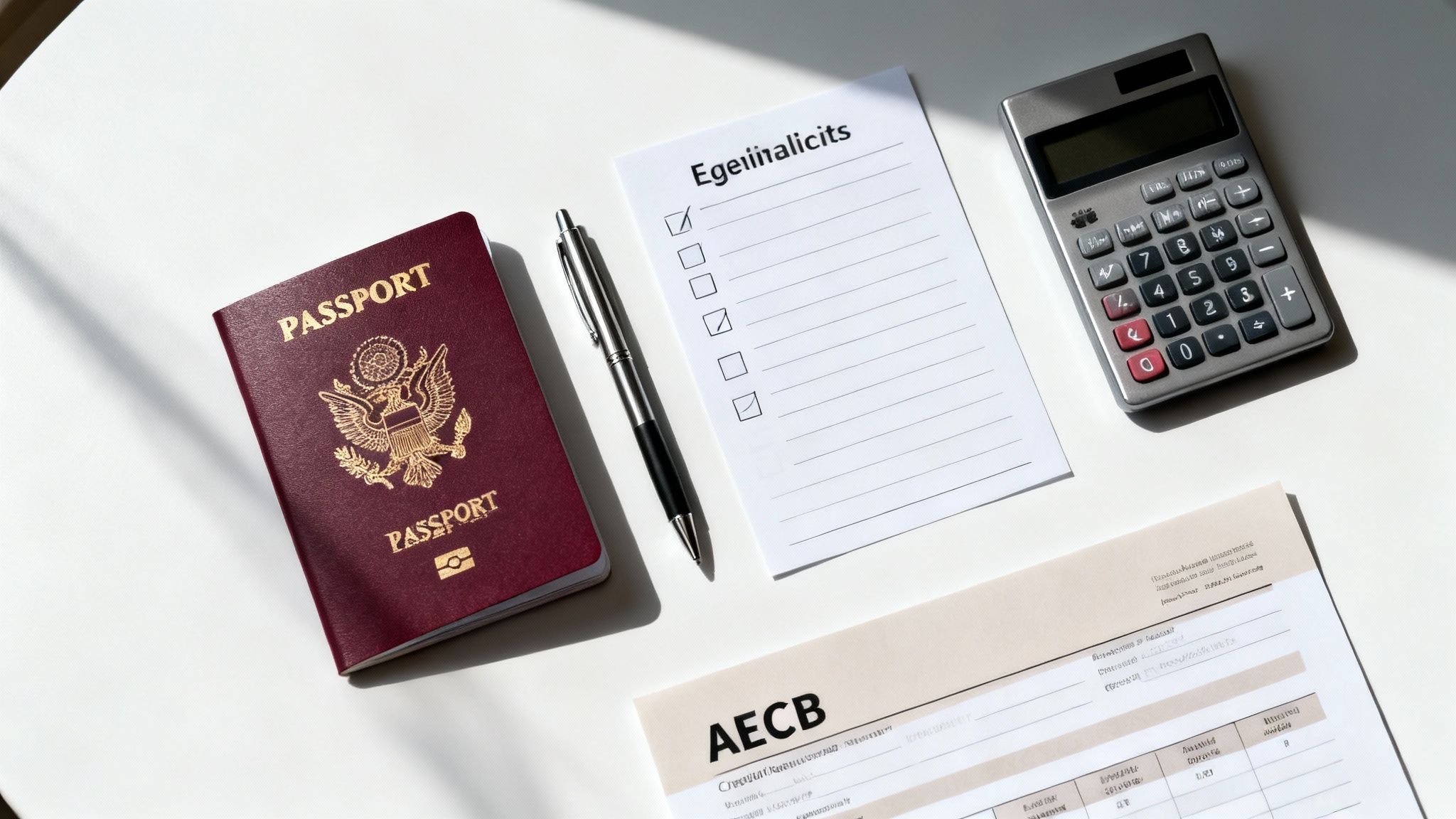
Getting a mortgage can feel like unlocking a door to your future—and it is. You just need the right set of keys. Lenders in Dubai aren't looking to create a complicated maze; they have a clear set of criteria that, once you understand them, takes all the mystery out of the process. This isn’t about jumping through hoops. It’s about confidently presenting your financial story in a way that banks understand and trust.
Whether you're a UAE National, an expatriate resident building a life here, or a non-resident investor seizing an opportunity, the path is well-defined. Think of it as building a case for your reliability. Factors like your residency status, age, and employment stability form the bedrock of your application.
Let's break down exactly what lenders are looking for.
The Three Pillars of Eligibility
Your journey to securing one of the best mortgages in Dubai starts with three core pillars. Lenders examine these to build a complete picture of you as a borrower, making sure the loan is a sustainable and successful venture for everyone involved.
Residency and Employment Status: This is the first thing a bank wants to know. It’s all about stability. Are you a salaried employee with a confirmed role, or are you self-employed with a proven business track record? Your employment type directly shapes the documents you’ll need to share.
Age and Loan Tenure: Most banks require applicants to be between 21 and 65 years old by the end of the loan term. For self-employed individuals, this can sometimes stretch to 70. The logic is simple: they want to ensure the mortgage is comfortably repaid during your primary earning years.
Financial Health: This is where we get into the numbers. Lenders will carefully review your income, any existing debts you have, and your overall credit history. They need to see a clear picture of your ability to manage monthly payments without a struggle.
Understanding Your Debt-Burden Ratio
One of the most crucial numbers in this whole process is your Debt-Burden Ratio (DBR).
Imagine your monthly income is a full glass of water. The UAE Central Bank has a rule: all your monthly debt payments—including your new mortgage, car loans, credit cards, and personal loans—cannot take up more than 50% of that glass.
The DBR isn't just a rule; it's a financial safeguard. It’s there to ensure you have enough breathing room each month, protecting you from overextending yourself so you can actually enjoy your new home without financial stress.
So, if your monthly income is AED 40,000, your total monthly debt repayments can’t go over AED 20,000. If you already have AED 5,000 in existing monthly payments for a car and credit card, the absolute maximum monthly mortgage instalment you could be approved for is AED 15,000. This simple calculation is central to how banks decide how much they can lend you.
Your Credit Score: The Key to Unlocking Better Rates
In the UAE, your financial reputation is neatly summed up by your Al Etihad Credit Bureau (AECB) score. This three-digit number, from 300 to 900, tells the story of your credit history. A higher score is like a letter of recommendation—it signals to lenders that you're a reliable borrower, which can unlock better interest rates and more favourable terms.
Lenders generally look for a score above 650, and anything over 700 is considered very strong. The best part is that this system is completely transparent. Before you even apply, you can check your own AECB report to see where you stand, fix any issues, and approach lenders from a position of real strength.
Eligibility Across Different Buyer Profiles
While the core principles are the same, the specific requirements for mortgages in Dubai do shift based on your residency status. Here’s a quick overview of how it usually breaks down.
Mortgage Eligibility at a Glance for Expats vs UAE Nationals
Criteria | Expatriate Residents | UAE Nationals |
|---|---|---|
First Property (Below AED 5M) | Up to 80% Loan-to-Value (LTV) | Up to 85% Loan-to-Value (LTV) |
First Property (Above AED 5M) | Up to 70% LTV | Up to 75% LTV |
Second Property (Any Value) | Up to 65% LTV | Up to 70% LTV |
Minimum Employment History | Typically 6 months with current employer | Often more flexible, with 3-6 months in a confirmed role |
Down Payment Requirement | Minimum 20% + associated fees | Minimum 15% + associated fees |
Maximum Age at Loan Maturity | Usually 65 years (salaried) | Usually 70 years |
As you can see, the differences directly impact how much of a down payment you’ll need to prepare.
UAE Nationals: Can often secure the highest Loan-to-Value (LTV) ratios, sometimes up to 85% of the property’s value for a first home.
Expatriate Residents: Typically qualify for LTVs up to 80%, with lenders often looking for a stable employment history in the UAE.
Non-Resident Investors: Naturally face the strictest criteria, usually with a maximum LTV of around 60-70%, which means a larger down payment is required to offset the perceived higher risk.
Understanding these distinctions is crucial, as is getting an accurate property valuation. Our team has put together a detailed article that walks you through this, and we highly recommend checking out our complete guide to property valuation in Dubai to learn more. With this knowledge, you can approach the mortgage process not as an applicant hoping for the best, but as a prepared buyer ready to succeed.
Choosing the Right Home Loan for You
Finding the perfect mortgage in Dubai isn't as simple as grabbing the one with the lowest sticker price. Think of it less like shopping and more like planning a long-distance road trip. You wouldn't take a sports car on a rugged mountain pass, would you? The same logic applies here. You need a loan that fits your financial roadmap, your comfort with a few bumps along the way, and where you see yourself in the years to come.
Let's break down the main types of home loans you'll find, using some real-world examples. This way, you can look past the jargon and find the mortgage that truly works for your life.
Fixed-Rate Mortgages: The Power of Predictability
For anyone who loves stability and a good night's sleep, the fixed-rate mortgage is your best friend. Imagine setting your home's thermostat to the perfect temperature and just leaving it there. That’s a fixed-rate loan. For an initial period, usually between one and five years, your interest rate is completely locked in. No surprises, no matter what the economy does.
This kind of predictability is a game-changer for budgeting. You'll know exactly what your biggest monthly outgoing is, making it incredibly easy to plan your finances without any stress.
Of course, there's a flip side. If market interest rates suddenly drop during your fixed period, you won't get to ride that wave down. Once that initial term is up, your loan will almost always switch over to a variable rate, which is tied to the bank's own lending rate.
Variable-Rate Mortgages: Riding the Market Waves
On the other hand, a variable-rate mortgage is more like a sailboat, built to harness the changing winds of the financial markets. Your interest rate is directly linked to the Emirates Interbank Offered Rate (EIBOR), plus a margin the bank adds on top. As EIBOR moves up or down, so will your monthly payments.
This can be a fantastic option if you believe interest rates are heading down, as your payments could shrink over time. Banks often offer lower initial rates on these loans to draw you in, which can make them look very attractive from the get-go.
The risk, naturally, is the unknown. If rates climb, your payments will follow, potentially putting a real squeeze on your budget. This loan is a better fit for someone with a bit more appetite for risk and the financial cushion to handle higher payments if the tide turns. A critical part of the process for either loan is knowing how to calculate mortgage payments to ensure you're prepared for the monthly commitment, especially if rates shift.
Exploring Specialised Financing Options
Beyond the big two, Dubai’s mortgage market has some fascinating and specialised products designed for very specific needs.
Islamic Finance: These are Sharia-compliant products that cleverly avoid charging interest (riba). You'll see structures like Murabaha, where the bank buys the property and then sells it back to you at a profit, paid in instalments. Another is Ijarah, which works a bit like a lease-to-own agreement.
Off-Plan Property Loans: Tailor-made for buying a property that hasn't been built yet. Lenders often partner with major developers, and they release the funds in stages as construction milestones are hit.
Equity Release or Home Equity Loans: This is a powerful tool for existing homeowners. It lets you borrow against the value you’ve already paid off in your property, giving you access to cash for things like renovations, a child's university fees, or other big investments.
Your mortgage isn't just a loan; it's a strategic decision that will shape your financial journey for years. You're not just buying a property—you're choosing the financial partner and the product that will help you achieve your long-term goals.
At the end of the day, the right mortgage comes down to your financial personality. Are you the type who craves certainty, or are you willing to embrace a little market movement for a potentially bigger reward? Understanding these fundamental differences is the key to confidently choosing the loan that will pave the smoothest path to owning your dream home in Dubai.
Your Step-by-Step Mortgage Application Blueprint
This is your roadmap to securing one of the best mortgages in Dubai. When you break it down, the application journey is just a series of clear, manageable stages. Think of it like preparing for a major trek—success comes from knowing the route and packing the right gear. With this guide, you can transform what feels like an overwhelming process into a confident and successful journey to homeownership.
The entire process is designed to give you structure and clarity, moving you from initial prep work to finally holding the keys to your new property. Each stage builds on the last, creating a logical path forward.
Let's walk through the key milestones on your adventure.
Stage 1: The Preparation Phase
Before you even think about speaking to a bank, your first job is to get all your essential documents in order. This is the 'packing' phase of your expedition. Getting your paperwork sorted out upfront saves a ton of stress and delays later on and, just as importantly, shows lenders you’re a serious, organised applicant.
Your document checklist will almost always include:
Proof of Identity: Your passport, visa, and Emirates ID are non-negotiable.
Proof of Income: This means recent salary certificates, bank statements for the last six months, and your latest payslips. If you're self-employed, you'll need to provide audited financial statements for your business.
Credit Report: Your Al Etihad Credit Bureau (AECB) report is your financial passport. A clean and positive report is absolutely crucial.
Stage 2: Securing Your Pre-Approval
Think of a mortgage pre-approval as your ‘boarding pass’ for property hunting. It’s a conditional commitment from a lender stating the maximum amount they’re willing to finance based on your initial financial profile. In Dubai's fast-moving market, this step is vital.
A pre-approval gives you two massive advantages. First, it defines your real budget, so you’re only looking at properties you can genuinely afford. Second, it signals to sellers and agents that you're a qualified buyer, giving you serious leverage when it's time to negotiate.
A mortgage pre-approval transforms you from a window shopper into a serious contender. It’s the single most important step to take before you start viewing properties, giving you the power to act decisively when you find the perfect home.
Stage 3: The Property Search and Offer
With your pre-approval locked in, the fun part begins: finding your dream home. Once you’ve identified a property, you'll make a formal offer through a Memorandum of Understanding (MOU). This document outlines the terms of the sale and requires a security deposit, typically 10% of the purchase price, which is held safely in escrow.
This is also the moment when a thorough property inspection becomes essential. Catching any potential issues before you finalise the deal can save you from very costly surprises down the road. To get a better sense of what's involved, check out our expert guide on property inspection costs in Dubai.
This visual guide breaks down the core mortgage types available as you navigate your financing options.
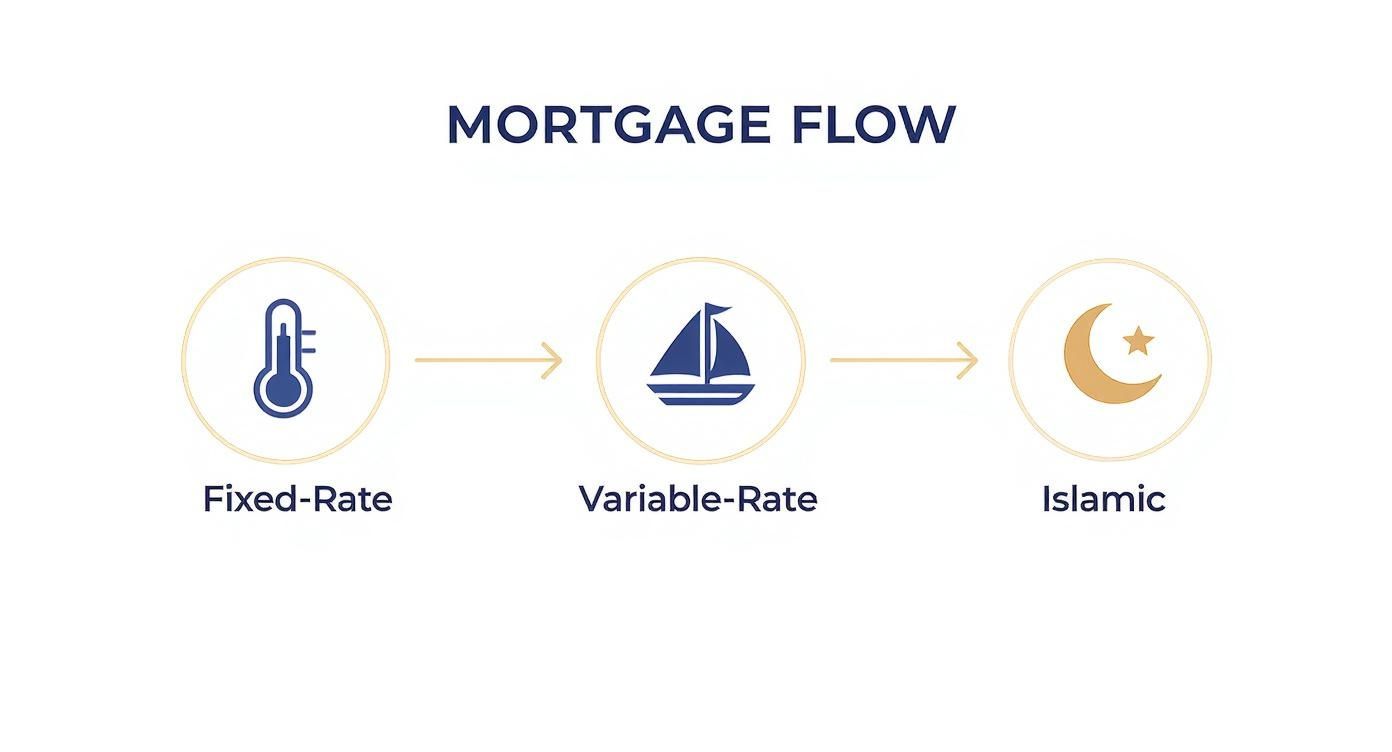
As the infographic shows, your main choices are between the stability of a Fixed-Rate, the flexibility of a Variable-Rate, or the unique principles of Islamic Finance.
Stage 4: Final Approval and Transfer
After the MOU is signed, your lender will arrange its own official valuation of the property to confirm it's worth the price. Once the valuation is done and all final checks are complete, the bank issues the Final Offer Letter. This is the green light you’ve been working towards.
The last hurdle is the property transfer at the Dubai Land Department (DLD) offices. This is where everyone meets, the final payments are exchanged, and the title deed is officially transferred into your name.
The market's energy is undeniable. In a single recent month, mortgage transactions jumped by 26.4% year-over-year to 4,668 transactions, showing just how active the financing scene is. This kind of data proves you're stepping into a thriving, diverse property market supported by very robust lending activity.
Congratulations—you are now a homeowner in Dubai! By following this blueprint, you've navigated the process with foresight and confidence.
Economic Trends Driving Dubai's Mortgage Market
Deciding to buy a property is a huge step. But deciding when to buy? That can be just as important. The story of Dubai's current mortgage market isn't just about interest rates; it's about a city that's firing on all cylinders, creating a powerful momentum you can be part of. Think of it less as a transaction and more as a chance to tie your own investment journey to a genuine economic success story.
Understanding the 'why' behind all this energy gives you a real strategic advantage. It’s the difference between just buying a property and making a confident, forward-thinking investment. Right now, several powerful economic currents are converging to make the landscape for mortgages in Dubai incredibly promising.
Government Vision and Infrastructure Growth
Dubai's ambitious government roadmaps, like the Dubai 2040 Urban Master Plan, aren't just ideas on paper. They are active projects shaping the city's future, backed by massive investment in everything from new metro lines to sprawling residential communities.
This kind of forward-thinking development does two brilliant things. First, it directly boosts the value and appeal of the properties around it. Second, it creates a stable, predictable environment where banks feel confident enough to offer really competitive mortgage products.
When you take out a mortgage in Dubai, you're not just buying into a single property. You are investing in a city with a clear, well-funded vision for growth and an unwavering commitment to becoming one of the world's best places to live.
A Buoyant and Confident Economy
The bigger economic picture is providing a fantastic tailwind for the property market. During the first quarter of the year, mortgage activity here absolutely surged. Across the key emirates, mortgage deals hit nearly 11,000 transactions worth a massive AED 41 billion—a 27% jump from the previous year.
Dubai was at the heart of this boom, propped up by a strong economy with a projected GDP growth of 5.1%. Fantastic conditions, like having no property ownership taxes and high rental yields that average 5–8% in prime spots, have turned real estate into an incredibly compelling investment. You can explore more insights into the UAE's 2025 mortgage market trends and see the numbers for yourself.
This strong performance fuels a cycle of confidence. As the economy grows, so does the demand for housing. That, in turn, supports property values and encourages lenders to say "yes" to more deals. When you understand these dynamics, you can invest with the assurance that your decision is backed by some seriously powerful economic fundamentals.
Common Questions About Dubai Mortgages
Even with the best map, you're bound to have a few questions on any journey. And diving into the world of mortgages in Dubai is no different. Think of this section as your friendly guide at the end of the trail, here to clear up those final thoughts and give you that extra bit of confidence.
We’ve pulled together some of the most common questions we hear from aspiring homeowners. Getting these answered helps put the final pieces of the puzzle into place so you can move forward with total clarity.
Can Non-Residents Get a Mortgage in Dubai?
Absolutely. This is probably the number one question we get, and the answer is a firm yes. Non-resident investors are a huge part of what makes Dubai's property scene so vibrant.
The terms, however, are a little stricter. To offset what they see as a higher risk, lenders will usually ask for a larger down payment—often in the ballpark of 40-50% of the property’s value. You'll also need to get your financial documents from your home country officially translated and attested, so be prepared for a bit of paperwork.
Why Is a Mortgage Pre-Approval So Important?
Think of a mortgage pre-approval as your golden ticket in Dubai's fast-moving property market. It's a formal, conditional commitment from a bank stating they're willing to lend you a specific amount, and it’s typically valid for 60-90 days.
This isn't just a nice-to-have; it's a strategic necessity. A pre-approval transforms you from a window shopper into a serious, qualified buyer. It gives you incredible negotiating power and lets you pounce the moment you find your dream home.
Without it, you risk losing out to cash buyers or other prepared applicants who can close the deal much faster. It also sets a realistic budget, which makes your property search way more focused and efficient.
What Are the Main Fees Involved?
The down payment is the big one, but there are a few other costs to factor into your budget. Knowing about these upfront is the key to a smooth process without any last-minute surprises.
Here are the key fees to expect:
Bank Arrangement Fee: This usually lands somewhere between 0.5% and 1% of the total loan amount.
Property Valuation Fee: A standard charge of around AED 2,500 to AED 3,500 for the bank to send out an expert to assess the property's official value.
DLD Mortgage Registration: The Dubai Land Department charges 0.25% of the loan value, plus a small admin fee to register the mortgage.
Mandatory Life Insurance: This is a non-negotiable for almost every mortgage in the UAE. It’s there to protect both you and the lender.
For a deeper dive, you can always explore our extensive https://www.cnco.ae/faq. And as you think about the long-term finances of your loan, it can be helpful to look into broader financial principles like strategies for maximizing mortgage interest deductions for general insight.
At Credence & Co., we provide RERA-accredited, technically robust property valuations that give lenders and buyers the confidence they need to proceed. Secure your property investment with an expert valuation today.


Comments