%20file.png)

Golden Visa UAE: Eligibility, Investments & Steps
So, what exactly is the UAE Golden Visa? Put simply, it’s a prestigious long-term residency permit, valid for a full 10 years and, crucially, it's renewable. It was created to draw in and keep global talent, investors, and entrepreneurs, giving them a solid foundation to live and work in the Emirates without needing a local sponsor.
Understanding the UAE Golden Visa

It’s best to think of the Golden Visa as more than just a permit—it's a long-term invitation to become part of one of the world's most vibrant economies. Standard residency visas usually need renewing every two or three years and are tied directly to your employer. The Golden Visa, on the other hand, provides a decade of stability and freedom.
This whole initiative is a key part of the UAE's bigger plan to build a future based on knowledge and innovation. By bringing in top-tier professionals and serious investment, the programme fuels growth in critical sectors like technology, real estate, and the creative industries. The main draw? The incredible freedom it gives you.
Core Advantages for Holders
The benefits go well beyond just living in the country. Holding a Golden Visa gives you a level of independence that was once only available to citizens, making it a top prize for global professionals and their families.
Here are some of the key perks:
No Sponsor Required: You are effectively your own sponsor, which means you have total independence from any single employer or company.
Extended Family Sponsorship: You can sponsor your spouse and children (with no age limit for unmarried dependents), as well as domestic staff.
Long-Term Security: The 10-year validity, combined with a simple renewal process, offers a stable base for planning your life and career.
Flexibility During Absences: Unlike other visas, you can stay outside the UAE for more than the usual six-month limit without your residency being cancelled.
The Golden Visa transforms your relationship with the UAE from a temporary arrangement into a long-term partnership. It signals a commitment from the government to those who invest their talent and capital in the nation's future.
Attracting Global Wealth and Talent
To really get a handle on the programme, it’s important to understand the specific UAE Golden Visa eligibility criteria. The system is deliberately designed to attract individuals who can make a real, substantial contribution to the country's growth.
And it’s clearly working. The Golden Visa programme has made the UAE a top destination for wealthy expatriates, leaving global competitors behind. According to the Henley Private Wealth Migration Report 2025, the UAE is expected to attract around 9,800 millionaires in 2025 alone—the largest inflow of any country in the world. This just goes to show how powerful the programme is at drawing in high-net-worth individuals who see the UAE as a safe, prosperous, and forward-thinking place to be. You can read more about the global race for wealthy expats on BusinessInsider.com.
Finding Your Golden Visa Pathway

Think of the Golden Visa application as a set of doors, each with a specific key. The UAE government has created several distinct pathways to long-term residency, and your first, most critical task is figuring out which key fits your profile. Choosing the right path from the start saves you time, money, and a lot of headaches down the line.
While there are various sub-categories, the system is built around three main pillars: Real Estate Investment, Entrepreneurship, and Exceptional Talent. Let’s break down what each one really means for you.
To help you see the options side-by-side, here’s a quick overview of the main eligibility routes.
UAE Golden Visa Eligibility Pathways at a Glance
Category | Minimum Investment/Requirement | Key Conditions |
|---|---|---|
Real Estate Investor | AED 2 million in property | Can be a single or multiple properties. Both off-plan and completed properties are eligible, with different processes. |
Entrepreneur | Project value of AED 500,000 or approved business idea | Requires approval from an accredited incubator or proof of a previously sold startup for over AED 7 million. |
Exceptional Talents | Based on professional achievement, not capital | Requires internationally recognised awards, patents, or accreditation from relevant UAE government bodies. |
This table gives you a snapshot, but the real story is in the details of each pathway.
The Real Estate Investor Pathway
This is, without a doubt, the most popular and straightforward route to a Golden Visa. It's designed for anyone looking to make a significant, tangible investment in the country’s booming property market. The headline requirement is simple: you need to own real estate with a minimum value of AED 2 million.
You can meet this threshold with a single apartment or villa, or by bundling a few smaller properties together. A common point of confusion is whether off-plan properties count. The answer is yes, they do, but the paperwork and valuation process will be quite different from that for a completed, ready-to-move-in property.
The real sticking point here isn't what you paid, but what the property is worth right now. A sales and purchase agreement from two years ago isn't enough. The government needs a current, independent valuation from a RERA-approved firm to confirm you meet the AED 2 million threshold.
If this sounds like your route, it’s worth getting into the nitty-gritty. Our guide on turning your property into a golden visa opportunity covers this in much more detail. You might also find it helpful to look into specific investor visa packages that bundle services for this exact purpose.
The Entrepreneur Pathway
The UAE isn't just looking for property investors; it's actively hunting for innovators who can add fuel to its economic engine. The entrepreneur pathway is built for founders with a solid track record or a brilliant, scalable business idea. Here, the focus shifts from pure capital to your project’s potential and credibility.
To qualify, you’ll need to tick one of these boxes:
Be the founder of a startup project with a minimum value of AED 500,000.
Have a business idea that gets the stamp of approval from an accredited business incubator here in the UAE.
Have previously founded and sold an entrepreneurial project for at least AED 7 million.
This isn't a "back of a napkin" idea pathway. You'll need a robust business plan and official approvals to show your venture is a serious enterprise ready to grow in the UAE. It’s a clear signal of the country's commitment to building a world-class startup hub.
The Exceptional Talents Pathway
The third major route isn't about what you can invest, but who you are. This pathway is reserved for people at the absolute top of their game—pioneers and world leaders in their fields. It’s the UAE’s way of attracting the planet’s brightest minds.
This "talent visa" casts a wide net, covering professions like:
Doctors and scientists
Inventors and creatives in culture and art
High-level executive directors
Specialists in niche scientific and engineering fields
Professional athletes
Holders of doctoral degrees
Each of these has its own specific benchmarks. An inventor needs an approved patent, a scientist needs published research in top-tier journals, and an artist needs accreditation from the relevant cultural authorities. This pathway truly highlights the nation's ambition to become a global centre for knowledge and creativity, offering a long-term home to those who are shaping our future.
Why Property Valuation Is Non-Negotiable

When it comes to the real estate investor pathway, there’s a common and costly mistake many applicants make. They assume the purchase price on their Sale and Purchase Agreement (SPA) is all the proof they need. This single misunderstanding is one of the biggest reasons applications get bogged down in delays or, worse, are rejected outright.
Let's be clear: the authorities aren't interested in what you paid for the property. What they need to see is its current, fair market value. This is the only number that truly counts when assessing if you meet the Golden Visa investment threshold.
Think of it like getting insurance for a piece of fine art. The insurer doesn't base the policy on what you bought it for at an auction years ago. They require a professional appraisal to determine its value today. Your Golden Visa application works on the exact same principle—the official valuation is the definitive proof of your investment’s present-day worth.
The Role of RERA-Approved Valuers
To keep the process fair and transparent, the UAE government insists that this valuation is carried out by an independent firm accredited by the Real Estate Regulatory Agency (RERA). These professionals act as impartial third-party experts, providing an objective assessment that both you and the immigration authorities can rely on.
Their job is to look beyond the original contract price and establish what the property would realistically fetch on the open market at the time of your application. This crucial step prevents the use of inflated or outdated figures and ensures a level playing field for every investor. It’s a cornerstone of the Golden Visa programme's integrity.
A RERA-approved valuer doesn't just glance at a property; they conduct a thorough inspection and analysis. If you're curious about what goes on behind the scenes, our guide helps to demystify the purpose and methods of property valuation.
Key Factors Influencing Your Valuation
A certified valuation is a detailed, systematic process. It's a blend of physical inspection and hard data analysis that all funnels down into one final, defensible number.
Here are some of the key elements they examine:
Property Condition: Is the building old or new? What’s the quality of the construction? Have there been recent upgrades, or is there visible wear and tear?
Location and Amenities: Proximity to essential infrastructure like schools, metro stations, and malls is a major value driver. The quality of community facilities, from gyms to swimming pools, also moves the needle.
Size and Layout: The total square footage, number of bedrooms, and the functionality of the floor plan are all fundamental to the valuation.
Comparable Market Analysis (CMA): This is a big one. Valuers dig into recent sales data for similar properties in the same building or neighbourhood to establish a solid benchmark for current market rates.
Market Trends: They also consider the bigger picture—broader economic conditions, supply and demand dynamics, and overall investor sentiment all have an impact.
The valuation report is the bedrock of your investment-based golden visa application. An outdated or inaccurate assessment can lead to an immediate rejection, while a professional, compliant valuation provides the authorities with the clear evidence they need to approve it.
The impact of the Golden Visa on the UAE property market is undeniable. Just look at Ajman, where recent reforms have sparked a huge surge in real estate activity. In the first half of 2025, the emirate recorded $3.38 billion in property transactions—a 37% jump from the previous year. This growth was largely fuelled by Golden Visa investors taking advantage of new rules allowing them to pool investments. This really shows how closely property values and visa eligibility are linked.
Your Roadmap to the Golden Visa
Applying for the Golden Visa can feel a bit daunting, like you've been handed a map to a treasure but with half the landmarks missing. Let's fix that. This is your clear, step-by-step guide, laid out by people who navigate this path every day, specifically for real estate investors.
Think of it as a series of checkpoints. Each one has its own set of tasks and a typical timeline. Getting the sequence right is the secret to a smooth, predictable journey. We'll walk through the entire process, from the initial checks on your property right up to the moment that 10-year visa is stamped in your passport.
Stage 1: The Foundation - Due Diligence and Valuation
Before a single application form is filled out, your journey starts with the property itself. This first stage is all about making sure your investment is compliant and its value is officially recognised. Getting this right prevents major headaches down the line.
Confirm Your Eligibility: First things first, double-check that your property (or your portfolio of properties) actually meets the rules. Is the title deed in your name? If it’s mortgaged or off-plan, do you understand the specific requirements for those scenarios?
Get an Official Valuation: This is a deal-breaker. You absolutely must get a valuation report from a RERA-approved firm to officially prove your property's current market value meets the AED 2 million threshold. This report is the bedrock of your application, so choosing a credible and experienced partner is essential. Learn more about the critical role of professional property valuation for your Golden Visa application to ensure you start on solid ground.
A standard valuation usually takes between 2 to 5 working days, depending on the property's complexity. Don't leave this to the last minute.
Stage 2: The Paper Trail - Gathering Your Documents
With your property’s value confirmed, it's time to switch into admin mode. This is about collecting a very specific set of documents for the immigration authorities. Be meticulous here—a single missing document can bring the whole process to a halt.
Here’s your core checklist:
Passport Copy: A clear, valid copy of your passport.
Current Visa/Entry Permit: Proof of your legal status in the UAE.
Passport-Sized Photograph: A recent photo that meets the official specs.
Title Deed Certificate: The official document proving you own the property.
Official Valuation Certificate: That crucial RERA-approved report from Stage 1.
Proof of Funds: If your property is mortgaged, you'll need a letter from the bank confirming the amount of equity you've paid.
Think of it like packing for an important international trip. You wouldn’t forget your passport or visa. Each item on this list is just as mandatory, and having them all organised and ready makes the journey through the official channels a breeze.
Stage 3: Going Official - Submission and Biometrics
Once your document portfolio is complete, you're ready to officially kick off the visa process. This is where you move from preparation to actively engaging with the UAE's government systems.
Here’s how it usually unfolds:
Online Application: Your application and scanned documents are submitted through the official government portal. You'll get a tracking number to keep an eye on things.
Initial Approval: After the documents are reviewed, you should receive an initial approval, typically within 5 to 7 working days. This green light lets you move on to the next steps.
Medical Fitness Test: You’ll need to complete a mandatory medical screening at a government-approved health centre. It’s a straightforward test that screens for communicable diseases.
Biometrics Appointment: Next, you’ll visit a designated centre to give your fingerprints and have your photo taken for your new Emirates ID card.
You will need to be physically present in the UAE for this part of the process, so be sure to plan your schedule to attend these appointments without any delays.
Stage 4: The Final Stretch - Approval and Visa Stamping
You’re on the home stretch. After your medical tests and biometrics are done, your application goes in for one final review. This is where the authorities make the final call, so a little patience goes a long way.
Once you get the final approval, the very last step is getting the Golden Visa physically stamped in your passport. You'll also receive your new Emirates ID card, which will be valid for a full 10 years. The timeline for this final stage can vary, but most applicants get their stamped visa within 3 to 5 working days after clearing all the previous steps.
By following this roadmap, what seems like a complex bureaucratic maze becomes a manageable set of clear, actionable steps, bringing you that much closer to securing your long-term residency in the UAE.
Avoiding Common Application Pitfalls
Applying for the Golden Visa can be a fairly smooth ride, but I’ve seen a few common mistakes trip people up, causing serious delays or even an outright rejection. The smartest move you can make is to learn from others’ missteps. These aren't just minor paperwork errors; they're fundamental oversights that can completely derail a strong application.
With the programme's massive popularity, officials are sifting through a huge volume of applications. Believe me, any submission that doesn't hit the mark is quickly put to one side. That’s why getting every detail right from the very beginning is more important than ever.
The Dangers of an Outdated Valuation
One of the most frequent—and costly—mistakes I see is submitting a property valuation that's out of date. Many people think the Sale and Purchase Agreement (SPA) from a year or two ago will do the trick. It won't. The authorities don't care what you paid for the property; they need to know its current market value right now, at the time you apply.
Real estate markets move. A property worth AED 2.2 million last year might only be valued at AED 1.9 million today. If that happens, you’re suddenly ineligible. Submitting old documents is a surefire way to get your application flagged, adding weeks, if not months, to your timeline while they wait for the right paperwork.
To get around this, you must get a fresh, official valuation from a RERA-approved firm right before you submit everything. This gives you a figure that’s current, credible, and compliant. For a closer look at this, check out our guide on the eight typical pitfalls you must dodge when pursuing a property valuation service.
Misunderstanding Mortgaged Property Rules
Another area where people get stuck is with mortgaged properties. You can absolutely use a mortgaged asset for your application, but the rules are very specific. The number that matters isn't the property's total value, but your paid-up equity. This is the amount you’ve paid off, and it must meet that AED 2 million minimum.
For instance, say your villa is valued at AED 4 million, but you still owe AED 2.5 million on the mortgage. Your actual equity is only AED 1.5 million, which means you don't qualify.
You’ll need to provide an official No Objection Certificate (NOC) and a clear statement from your bank showing the total value, the outstanding mortgage, and your paid-up amount. Just handing over a Title Deed for a mortgaged property without this proof of equity will earn you an immediate query from the authorities.
When you have all your documents in perfect order, the process flows smoothly, just like this:
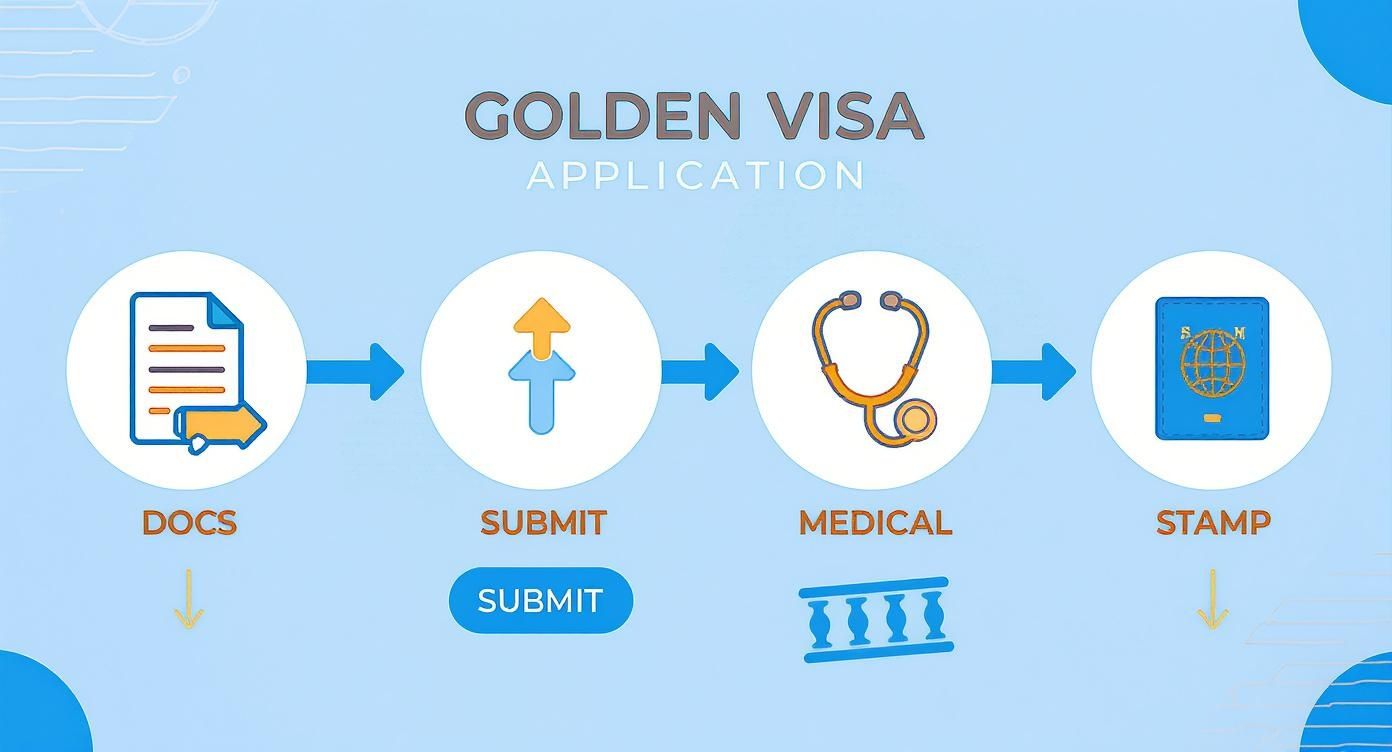
This shows how a well-prepared application moves seamlessly from one stage to the next, which really drives home the importance of getting the details right from the start.
The Critical Need for Proper Document Attestation
Finally, a surprisingly common slip-up is failing to get documents properly attested. Any official papers issued outside the UAE—think marriage certificates, birth certificates for your kids, or academic degrees for the talent visas—have to be authenticated. This means they need a stamp from the UAE embassy in your home country and from the Ministry of Foreign Affairs (MOFA) here in the UAE.
It's a process, and it takes time. An unattested document is essentially invalid for official use here. It will be rejected, forcing you to start the whole attestation process from scratch and resubmit, which can set you back significantly.
Getting ahead of these common issues—valuation, mortgage equity, and document attestation—is what turns a potentially stressful application into a straightforward one. It's all about anticipating what's needed instead of just reacting to problems as they pop up.
Got Questions About the Golden Visa? We've Got Answers.
Even with the clearest instructions, you’re bound to have questions pop up along the way. That’s perfectly normal. We’ve handled countless Golden Visa applications, and we hear the same queries time and again. Think of this section as sitting down with an expert who’s seen it all.
Let's cut through the noise and get you the straightforward answers you need.
Can I Apply With a Mortgaged Property?
Absolutely. This is one of the most common questions we get, and the answer is yes—but with one crucial detail. It’s not about the total price tag of your property; it’s all about your paid-up equity.
Essentially, the amount you’ve already paid off to the bank must be at least AED 2 million.
Let’s say you own a villa valued at AED 5 million. If you still owe the bank AED 3 million, your paid-up portion—your equity—is AED 2 million. In that scenario, you’re good to go. You'll just need to get an official letter from your bank clearly stating how much of the mortgage you've paid off. This isn't just a suggestion; it's a mandatory piece of evidence for your application file.
Is the Golden Visa a Pathway to UAE Citizenship?
This is a big one, and the short answer is no. The Golden Visa is a long-term residency programme, not a direct route to a UAE passport. It gives you a renewable, 10-year permit to live, work, and study here with your family.
It's an incredible status that offers stability and a host of benefits, but it doesn't grant you the rights of a UAE national. The process for UAE citizenship is entirely separate and managed under a very different, and highly selective, set of government criteria.
What If My Property’s Value Dips Below the AED 2 Million Mark?
Real estate markets go up and down. It's a reality every investor faces. So, what happens if your property value drops after your visa is issued?
Here’s how it works: the official valuation matters at two specific points in time—when you first apply and when you renew.
Once you have your 10-year Golden Visa in hand, you generally don't have to worry about market dips during that period. However, when it’s time to renew after a decade, you’ll need to prove you still meet the requirements. That will almost certainly mean getting a fresh, updated valuation to confirm the property's current worth.
This really brings home the importance of a smart investment from day one. Picking a property with solid, long-term value potential isn't just good for your wallet; it makes renewing your visa a much smoother process down the road.
Can I Bundle a Few Properties Together to Qualify?
Yes, you can. The rules are flexible enough to allow you to combine the value of up to three properties to hit that AED 2 million investment threshold. This is great for investors who prefer to diversify their portfolio rather than putting all their capital into a single asset.
Just be sure to follow a few simple rules:
Sole Ownership: Every property you include must be registered in your name only.
Proof of Ownership: You'll need to provide the official Title Deed for each property.
Individual Valuations: Each property needs its own approved, independent valuation report. The authorities will look at the total combined value from these reports to confirm you’ve met the minimum investment.
For even more answers to specific questions, feel free to check out our comprehensive FAQ page.
A successful Golden Visa application, especially one built on real estate, stands or falls on the quality of its paperwork. An independent, RERA-approved property valuation isn’t just a box to tick—it’s the very foundation of your file. At Credence & Co., our expert valuers deliver the solid, technically sound reports that prevent the common hiccups that lead to delays or rejections. Secure your compliant property valuation with Credence & Co. today and move forward with confidence.


أثناء التنقل المستمر بين المعلومات والمهام اليومية، بدأت ألاحظ أن العقل يتعامل مع التفاصيل بطريقة أكثر تعقيدًا مما نعتقد، وأن الانتباه يتغير بشكل مستمر حتى في اللحظات التي تبدو هادئة. وفي هذا الإطار ظهر https://melbetegypt.org/ كجزء من هذا التدفق الرقمي العام، دون أن يشكل نقطة محورية. ما أثار اهتمامي لم يكن الموقع نفسه، بل ملاحظة كيف يتفاعل الذهن مع الاختلافات الصغيرة في التنظيم والإيقاع البصري: أحيانًا يبقى التركيز واضحًا ومنظمًا، وأحيانًا يبدأ بالتشتت تدريجيًا دون سبب ظاهر. هذا النوع من المراقبة جعلني أفكر أكثر في الطريقة التي يعمل بها العقل وسط الكم الهائل من المؤثرات اليومية، وكيف أن الوعي بهذه التفاصيل يمنح فهمًا أعمق للحالة الذهنية. وفي النهاية، يصبح الانتباه نفسه شيئًا يستحق الملاحظة والتأمل أكثر من أي عنصر آخر.