%20file.png)

Mastering Investment Valuation for UAE and GCC Businesses
- Credence & Co
- Dec 9, 2025
- 15 min read
Every business tells a story—a story of late nights, bold risks, and hard-won victories. But how do you translate that human effort into a number that resonates in a boardroom or with a potential investor? This is where the art and science of investment valuation come into play. It’s about so much more than spreadsheets and formulas; it’s about uncovering the true, objective worth of your company.
Think of it less as a cold, financial exercise and more as creating a detailed blueprint for your company's future. You wouldn't build a skyscraper without a blueprint, so why navigate critical business decisions like a merger, sale, or funding round based on gut feeling alone? A solid valuation gives you a clear, unshakeable understanding of where you are today and, more importantly, where you can realistically go tomorrow.
Unlocking Your Company’s True Worth
At its core, a professional valuation gives you strategic clarity. It cuts through the noise and emotion, transforming abstract potential into a tangible figure that everyone—from shareholders to potential buyers—can understand and respect.
This clarity becomes absolutely essential during pivotal moments in your company's lifecycle. It’s the foundation for confident, well-informed decisions that can define your future success.
When Is a Valuation Non-Negotiable?
Certain business events demand more than just an estimate; they require a defensible, professionally prepared valuation. Let’s look at the most common scenarios.
Securing Funding: When you walk into a room with investors, a credible valuation is your greatest asset. It proves you’ve done your homework and understand your company’s position in the market, dramatically boosting your chances of securing that crucial capital.
Navigating Mergers & Acquisitions: In the high-stakes world of M&A, valuation is the bedrock of negotiation. Whether you are on the buying or selling side, an objective valuation ensures you’re arguing from a position of strength and not leaving money on the table.
Planning a Prosperous Exit: For any founder dreaming of a successful exit, a formal valuation is the very first step. It sets a realistic benchmark and helps you craft a strategy to maximize your return when it’s time to step away.
If you’re operating in the GCC, understanding the local nuances is key. For a more detailed look, check out our guide on how to value a company in the UAE.
An investment valuation is the financial articulation of your company’s past performance, present position, and future promise. It is the language that investors, partners, and markets understand.
A crucial part of this process involves a diligent earnings call analysis, which offers deep insights into a company's financial health and strategic direction.
Understanding your company’s value isn’t just a nice-to-have; it's a fundamental requirement for strategic growth. It empowers you to negotiate smarter, attract the right partners, and confidently lead your business in the dynamic GCC market. It’s the first step in turning your ambition into tangible achievement.
The Three Pillars of Valuation Methods
Figuring out what a company is truly worth isn't about landing on a single, magic number. A credible investment valuation is built on three distinct but interconnected approaches. Each one gives you a unique angle on the business, and when you bring them together, you get a powerful, defensible picture of its value.
I like to think of it like appraising a masterpiece. One expert might focus on the artist's future earning potential. Another might compare it to what similar works have recently sold for at auction. A third might simply tally up the cost of the canvas, paints, and frame. All three perspectives are valid, and you need them all for a complete appraisal.
Knowing your true worth is the first crucial step toward hitting major strategic goals—whether that’s securing funding, making an acquisition, or planning your exit.
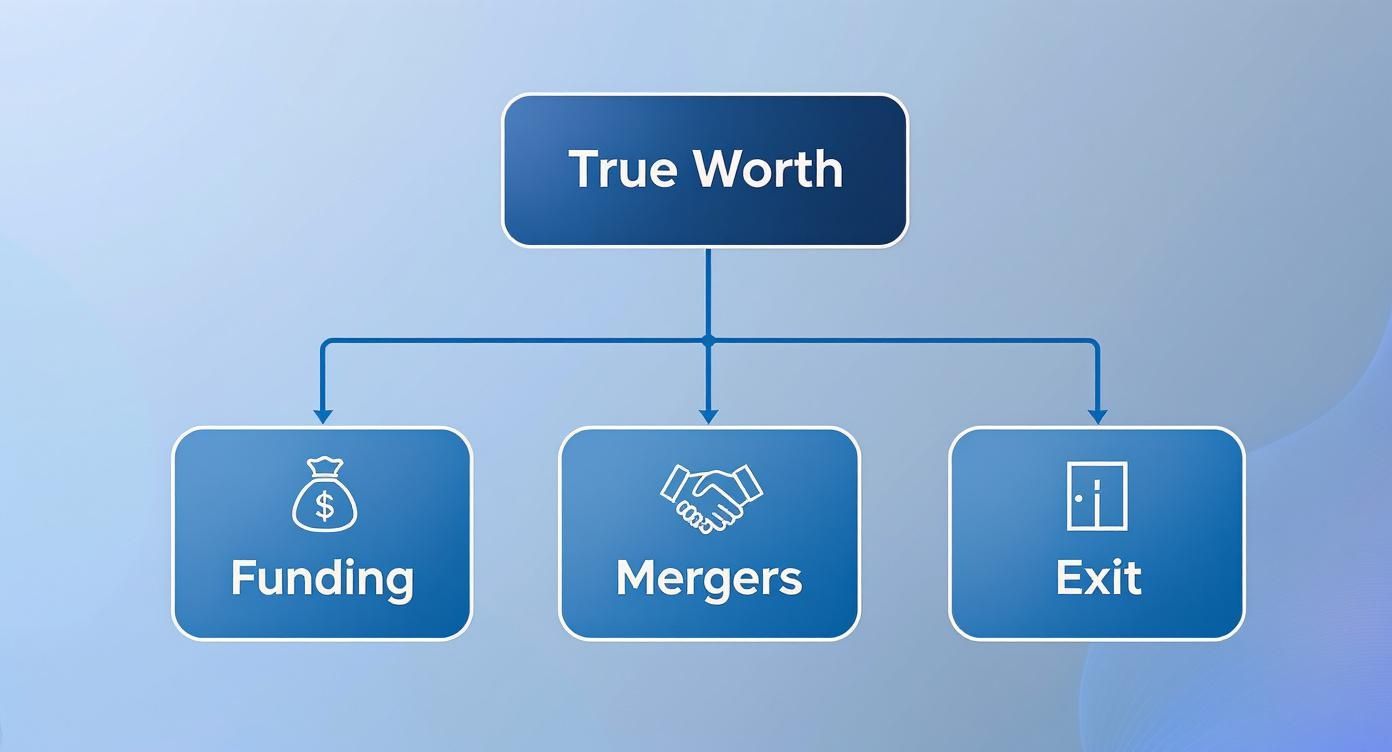
As you can see, a solid valuation isn’t the end of the road; it’s the launchpad for your company’s biggest milestones.
The Income Approach: A Glimpse into the Future
First up is the Income Approach. This is all about looking forward and valuing a business based on the cash it’s expected to generate down the line. The go-to method here is the Discounted Cash Flow (DCF) analysis.
Think of it like planting a date palm. Its value today isn't just what you paid for the seedling. It's the present-day value of all the future harvests you'll get from it over its entire life. The DCF model does the same thing for a business: it projects future cash flows and then "discounts" them back to what they’re worth in today's money, factoring in all the risks along the way.
This approach is incredibly useful for established companies with a steady track record and for high-growth startups where the future potential is the real story. To really get a handle on this, it's worth exploring the specifics of the income-based valuation in more detail.
The Income Approach asks a simple, powerful question: "Based on all the money this business is expected to make, what is it worth right now?"
The Market Approach: Value Through Comparison
Next, we have the Market Approach, which works on the simple idea of substitution. It determines a company’s value by seeing what similar businesses are worth, either through recent sales or public stock prices.
It’s a lot like valuing a villa in Dubai Marina. A real estate agent will look at the sale prices of comparable properties in the same building or neighbourhood—similar size, similar view, similar condition—to arrive at a fair market price. For businesses, we look at transaction multiples (like Enterprise Value to EBITDA) from recent M&A deals or what publicly traded "comps" are valued at.
This method gives your valuation a reality check, grounding it in what real buyers in the current market are actually willing to pay.
The Asset-Based Approach: The Sum of the Parts
Finally, the Asset-Based Approach gives us a tangible, nuts-and-bolts view of value. It calculates what a company is worth by adding up everything it owns and subtracting everything it owes.
It's a straightforward inventory check: tally up all the assets—from real estate and machinery to patents and inventory—and then subtract all liabilities. What’s left is the company's Net Asset Value (NAV). While it can sometimes miss the mark by ignoring intangible assets like brand reputation, it provides a crucial "floor" for the valuation. It tells you the absolute minimum the company is worth, even in a liquidation scenario.
To bring these ideas to life, you often need to get comfortable with key Excel financial formulas like NPV and IRR, which are the tools of the trade for assessing value.
Comparing Core Investment Valuation Methods
Each of these methods tells a different part of the story. To make it clearer, here’s a quick breakdown of how they stack up against each other.
Valuation Method | Core Principle | Best Suited For | Key Challenge |
|---|---|---|---|
Income Approach | A company’s value is the present value of its future earnings or cash flows. | Mature companies with stable cash flows; high-growth startups with predictable future potential. | Projections are based on assumptions, which can be subjective and carry inherent risk. |
Market Approach | A company’s value is determined by what similar companies are worth. | Industries with many public companies or a high volume of recent M&A activity. | Finding truly comparable companies is tough; no two businesses are identical. |
Asset-Based Approach | A company’s value is the sum of its assets minus its liabilities. | Asset-heavy industries (e.g., real estate, manufacturing); distressed or liquidation scenarios. | Often ignores intangible value drivers like brand, intellectual property, and goodwill. |
Ultimately, a truly comprehensive valuation doesn’t just pick one method. It synthesises insights from all three to build a complete and compelling narrative about your company’s worth.
Navigating High Stakes Mergers and Acquisitions
In the world of mergers and acquisitions (M&A), a professional investment valuation is so much more than just a number on a page. It's the blueprint for the entire deal. Every successful transaction is built on a foundation of solid numbers and strategic insight. Without it, both the buyer and the seller are flying blind during one of the most critical moments in their company’s history.
A thoughtfully prepared valuation delivers the clarity you need to move forward with confidence. It’s the key difference between a deal that creates incredible, long-term value and one that ends in disappointment and financial strain.

Different Sides, Shared Goal
An M&A negotiation naturally puts buyers and sellers on opposite sides of the table, but a credible valuation serves both of their interests. How? By anchoring the entire conversation in objective reality. Each side simply uses it as a strategic tool to reach their specific goals.
For the Seller: A defensible valuation is your best defence and your sharpest negotiating tool. It establishes a strong, fact-based starting point, wards off lowball offers, and gives you the power to clearly communicate your company's true potential. This isn't just about what your balance sheet says today; it's about telling the story of your future growth in a language that buyers respect.
For the Buyer: For you, the valuation is a compass. It steers you away from the dangerous trap of overpaying. It gives you a disciplined framework to assess the target company's worth on its own and, just as importantly, helps you quantify the potential synergies that justify paying a premium. This analytical rigour turns a potential gamble into a sound investment.
Ultimately, a professional valuation transforms what could be a tense negotiation into a productive dialogue focused on a fair outcome for everyone.
The MENA Region’s M&A Boom
The Middle East and North Africa (MENA) region has become a hotbed of M&A activity. In the first half of a recent year alone, deal values soared to $58.7 billion—a staggering 30% increase from the previous year. This boom was driven by a five-year high in cross-border deals, which accounted for 55% of all transactions and an incredible 78% of the total deal value. The UAE and Saudi Arabia led the charge, responsible for 87% of this outbound investment.
In such a dynamic market, having a precise and defensible valuation isn't just an advantage; it's an absolute necessity for any company hoping to be part of this growth.
A strategic investment valuation in an M&A context is not about finding a price; it's about uncovering the story of combined future value and telling it with undeniable clarity and credibility.
More Than a Number: A Strategic Blueprint
A truly powerful M&A valuation goes far beyond simple number-crunching. It becomes a strategic roadmap for the entire transaction, offering critical insights that shape every single stage, from the first conversation to the final integration.
Here’s how a deep valuation process adds strategic layers to a deal:
Identifies Synergies: It helps you quantify the "1+1=3" potential by modelling cost savings (like consolidating operations) and new revenue streams (like cross-selling to new markets).
Uncovers Hidden Risks: The due diligence baked into the valuation process can shine a light on operational weaknesses, legal liabilities, or market risks that weren’t obvious at first glance.
Builds the Business Case: It provides the hard evidence you need to get board approval and secure financing, presenting a compelling, data-driven argument for the deal.
Supports Purchase Price Allocation (PPA): After the deal is done, the valuation is essential for financial reporting, helping you correctly allocate the purchase price to all the acquired assets and liabilities.
Given the complexities, expert guidance is crucial. To understand more about navigating this terrain, explore our detailed services for mergers and acquisitions in Dubai. In the fast-moving M&A world of the GCC, a professional valuation is the one tool that gives you the confidence to close deals that deliver real, strategic success.
Valuation Strategies for Raising Capital
Bringing in capital from a private equity (PE) or venture capital (VC) fund isn't just a transaction; it's a pivotal moment in your company's life. This is where your investment valuation stops being an academic exercise and becomes the cornerstone of a high-stakes negotiation.
For ambitious, high-growth companies, the entire conversation about value shifts. It moves away from what you've done in the past and zooms in on the incredible potential of what you can achieve in the future.
Investors in this league aren't just buying a piece of your current balance sheet—they're investing in a vision. They're betting on your team's ability to conquer a market, scale with lightning speed, and deliver exceptional returns. Grasping this forward-looking mindset is the absolute key to framing your company's value in a way that truly connects and builds confidence.
Thinking Like an Investor
When a VC or PE firm looks at a high-growth business, they see things differently. Traditional metrics like today's profits or physical assets often fade into the background. These investors are strategists, and their eyes are trained on a unique set of signals that point to explosive growth potential.
Frankly, they are far less concerned with what your company is today and infinitely more interested in what it's destined to become. This perspective demands a valuation approach that champions possibility and market opportunity over historical performance.
Here’s what really gets their attention:
Total Addressable Market (TAM): This isn't just about who your customers are now. It's the entire revenue ocean you could be swimming in. A vast and expanding TAM suggests that even a small slice of the pie can translate into massive revenue.
A Scalable Business Model: Investors hunt for models where revenue can grow exponentially without costs growing at the same rate. Think of software-as-a-service (SaaS) platforms or other digital-first businesses.
The Strength of Your Team: Especially in the early days, investors are betting on the jockey as much as the horse. A leadership team with a proven track record, deep industry know-how, and sheer grit is a priceless asset.
Your Competitive Moat: What makes your business hard to copy? It could be proprietary technology, a powerful brand, exclusive partnerships, or network effects that strengthen with every new customer.
For venture capitalists and private equity investors, a valuation is not a snapshot of the present. It is a carefully constructed forecast of future triumphs, backed by a compelling narrative of market dominance.
Adapting Valuation Methods for Growth
Given this laser focus on the future, standard valuation methods need a rethink. An asset-based valuation, for instance, would completely miss the immense intangible value of a disruptive tech startup.
The Discounted Cash Flow (DCF) method is still a powerful tool, but it's adapted to model aggressive, long-term growth forecasts. At the same time, the Market Approach becomes incredibly important. We look at multiples from recent funding rounds of similar startups to create a realistic benchmark. This isn't about finding an identical twin for your company; it's about gauging the market's current appetite for risk and growth in your specific sector.
This process is anything but casual; it demands serious rigour. That's why completing a thorough financial due diligence in Dubai is an essential first step before you even think about approaching investors.
Capitalising on Regional Momentum
Right now, the investment landscape across the Middle East is buzzing with opportunity. The private equity market in the Middle East and Africa (MEA) was recently valued at a staggering USD 45.61 billion. And it's not slowing down—it's projected to grow at a CAGR of 10.61%, hitting USD 75.51 billion by 2030.
A huge portion of this capital is flowing directly into the technology software sector, which attracts 18.9% of all PE investments. You can discover more insights about these regional private equity trends on mordorintelligence.com.
This flood of available capital is a game-changer. By stepping into the investor's shoes and presenting a valuation rooted in future potential, you can build an investment case that's impossible to ignore. This strategic alignment puts you in a position of strength at the negotiating table, helping you secure the right partnership and the fuel needed to turn your bold vision into a market-leading reality.
Understanding Regional Market Drivers

A company's value is never determined in a vacuum. It’s deeply intertwined with the economic soil in which it grows. For businesses in the UAE, Oman, and the broader GCC, this means any expert investment valuation has to look beyond the balance sheet and analyse the powerful regional forces that shape both opportunity and risk.
Think of it like a master sailor navigating the Arabian Gulf. Knowing your own ship is essential, but success truly depends on understanding the currents, winds, and tides. Similarly, grasping the macroeconomic drivers of the GCC allows you to anticipate market shifts and build a valuation that is not just technically sound, but commercially brilliant.
These regional dynamics aren't just background noise; they are active ingredients that can dramatically increase or decrease a company's perceived worth in the eyes of savvy investors.
Government Vision and Economic Diversification
For decades, the GCC's economic story was written in oil. Today, a new chapter is being penned, driven by ambitious government initiatives aimed at building diversified, knowledge-based economies. This strategic pivot away from hydrocarbon dependency is the single most important market driver influencing valuations in our region.
Visionary plans like the UAE's 'We the UAE 2031' and Oman's 'Vision 2040' are more than policy documents; they are roadmaps to future value creation. These initiatives pour billions into specific non-oil sectors, creating incredibly fertile ground for growth.
An astute valuation professional connects your business directly to these national priorities. They show how your company aligns with and benefits from this top-down economic transformation—a powerful narrative that resonates deeply with local and international investors alike.
Foreign Investment as a Barometer of Confidence
Foreign Direct Investment (FDI) is a fantastic indicator of global confidence in a region’s stability and growth prospects. Tracking where the smart money is heading gives us a powerful leading indicator for sector-specific valuation trends. Recent FDI flows across the wider MENA region highlight incredible momentum, especially in renewable energy and tourism.
For example, Morocco's massive push for renewable energy, aiming for renewables to supply 52% of its energy by 2030, has attracted enormous foreign capital. In another landmark move, a UAE investment of US$35 billion into Egypt’s Ras El Hekma development signals massive confidence in regional tourism. You can learn more about these MENA foreign direct investment trends on spglobal.com.
These large-scale investments create a ripple effect, lifting the valuations of companies throughout the supply chain and signalling a very bright future for assets in these evolving sectors.
A business valuation that ignores regional market drivers is like a photograph without colour—it captures the form but misses the life. True value is revealed when a company’s story is told within the context of its dynamic environment.
By understanding these powerful forces, from government-led diversification to the clear signals sent by FDI, you can articulate a far more compelling value proposition. It shows that your company isn't just succeeding today, but is perfectly positioned to capture the immense opportunities of tomorrow’s GCC economy.
Your Partner in Strategic Valuation
We’ve walked through the core methods, unpacked high-stakes transactions, and explored the unique pulse of the GCC market. What I hope has become crystal clear is that a professional investment valuation isn’t just some compliance checkbox. It’s the single most powerful tool you have for turning bold ambition into tangible reality.
Think about it. A credible valuation gives you the clarity to secure capital on your terms, the confidence to pull the trigger on a game-changing merger, and the foresight to map out a successful exit. It takes your company’s story—all the hard work, the vision, the potential—and translates it into the universal language of value. That's a language every investor and boardroom understands and respects.
From Theory to Action
What separates a wildly successful deal from a missed opportunity? More often than not, it boils down to one thing: preparation. An objective, defensible valuation is the ultimate form of preparation. It grounds your entire strategy in fact, letting you walk into any negotiation from a position of undeniable strength.
Here at Credence & Co., our specialty is translating your company's unique story into a robust valuation that withstands the most intense scrutiny. Our roots are deep in the UAE and GCC markets, which means we get the subtle nuances that drive value in this dynamic region. We make sure your valuation isn’t just accurate—it's commercially sharp.
Your company’s true worth is its greatest asset. A professional valuation is the key that unlocks its power, enabling you to build, grow, and achieve your most significant goals.
This is the moment to shift from learning to doing. Your growth journey is unlike any other, and truly understanding its value is the critical next step. Don't leave your company's future to guesswork. It's time to put its true worth to work and build a lasting legacy.
For those ready to take that decisive step, learning more about our professional business valuation services will give you the clarity you need to move forward. Reach out and connect with our RICS-qualified experts today. Let's explore how a strategic partnership with Credence & Co. can help you confidently achieve your most ambitious goals.
Your Questions on Investment Valuation, Answered
Stepping into the world of investment valuation can feel a lot like trying to decipher a new language. As you work to translate your company's story and success into a credible number, it's only natural to have questions. We hear them all the time from smart, ambitious leaders just like you.
Think of this as your go-to guide. We’ve compiled the most common queries and provided straightforward answers, helping you walk into any negotiation with investors, partners, or buyers with total confidence.
How Often Should My Business Be Valued?
At a minimum, you need a formal valuation before any major transaction—think raising capital, selling the business, or even bringing on a key partner. This isn't just a formality; it's the bedrock of a fair and successful deal for everyone involved.
But the most strategic businesses don't just wait for a big event to pop up. They make valuation an annual health check, folding it right into their strategic planning. This proactive rhythm helps you track your progress, spot new ways to create value, and ensures you're ready to seize an opportunity the moment it appears.
What Is the Difference Between Valuation and Price?
This is probably one of the most critical concepts to grasp, and it boils down to the difference between a calculated estimate and a real-world handshake.
Valuation is what the numbers, models, and objective analysis say your business is worth. Price is what someone actually pays for it.
The final price can land above or below the valuation. Why the gap? It's all about the human and strategic elements that a spreadsheet can't capture—things like fierce negotiation, a bidding war between eager buyers, or the unique strategic fit your company offers a particular acquirer.
Can I Use Online Valuation Tools?
Those online calculators can be tempting for a quick, back-of-the-napkin number. But for any serious business decision, they simply don't cut it. These tools rely on generic formulas and public data, which means they miss everything that truly makes your business special.
They simply can't account for:
Your unique competitive edge in the market.
The subtle, but critical, nuances of your industry.
The specific economic realities and risks of operating in the GCC.
When the stakes are high, you need a detailed, defensible valuation from a professional firm. It’s the only way to build true credibility with investors, buyers, and financial partners.
What Are the Most Common Valuation Mistakes to Avoid?
A credible valuation is all about avoiding the common traps. The most frequent errors we see aren't about complex math; they're about a lack of objectivity and preparation.
The biggest stumbles include starting with unrealistic expectations, relying on messy or incomplete financial records, and forgetting to "normalise" the numbers by removing one-off expenses or windfalls that aren't part of your regular operations. Other missteps include picking a valuation method that doesn't fit your industry or overlooking the unique risks of the regional market. An experienced partner keeps the process objective and helps you sidestep these costly mistakes.
At Credence & Co., our job is to bring clarity to these complex questions, turning your valuation from a simple number into a powerful strategic asset. See how our RICS-qualified experts can help you achieve your goals at https://www.cnco.ae.


Comments