%20file.png)

Real Estate Project Planning in the UAE
- Credence & Co
- Nov 29, 2025
- 17 min read
Let's be blunt: a great idea in real estate development means nothing without a rock-solid plan. Project planning is what separates the glossy brochure from a profitable, standing asset. It’s the master blueprint, not just for the building itself, but for the entire business venture.
Why Project Planning Is Your Most Critical Investment
In the high-stakes world of asset development, execution is everything. This is where meticulous project planning becomes the bedrock of your success. It’s the disciplined process of pinning down your goals, defining exactly what you’re building, and mapping out every single step to get there—on time and on budget.
Think of it like an expedition. You wouldn’t just start walking into the wilderness without a map, a compass, and a clear destination. In development, your project plan is that navigational chart. It provides direction, helps you see the storms on the horizon, and makes sure your entire team is pulling in the same direction. Without it, projects inevitably drift, costs balloon, and deadlines become a distant memory.
Defining the Path to Profitability
A truly effective plan does more than just tick off a list of tasks; it brings order to the chaos of a complex development. You gain this control by focusing on several core pillars:
Scope Definition: Getting crystal clear on what is—and just as importantly, what is not—part of the project. This is your best defence against expensive scope creep down the line.
Resource Management: Smartly allocating your people, materials, and equipment to get the most bang for your buck.
Timeline Forecasting: Setting realistic, achievable schedules for every phase, from the first shovel in the ground to the final handover.
Risk Mitigation: Actively looking for trouble before it finds you. A good plan identifies potential threats and builds in strategies to handle them.
This structured approach is non-negotiable in dynamic markets like the UAE, which has cemented its status as a Middle East infrastructure hub, locking in $34 billion in awarded projects during 2023 alone. As private funding becomes more critical, a well-documented plan is essential for winning over investors and sailing through due diligence. You can dive deeper into the region's project investment trends in the full 2025 survey from PwC.
A project without a critical path is like a ship without a rudder. It’s your project plan that provides that rudder, letting you steer confidently through market turbulence and towards a profitable destination.
Ultimately, the time and money you invest upfront in comprehensive planning will be the single best financial decision you make. It converts ambiguity and risk into a clear, manageable sequence of steps, bridging the gap between a bold vision and a valuable asset.
Getting this foundation right is everything. It allows you to navigate the complexities of any project with confidence. For those looking to master this crucial discipline, you can learn more about expert real estate consulting for UAE and GCC markets and see how it underpins successful development.
Navigating the Five Cornerstone Phases of Development
A real estate project isn’t a single event; it's a journey. Smart project planning gives this journey a clear structure, breaking down what seems like a monumental task into a series of distinct, manageable phases. Each phase has its own purpose, its own challenges, and its own set of critical decisions.
Think of it like this: viewing a development as a five-part lifecycle demystifies the entire process. It transforms a massive undertaking, like building a luxury beachfront property in Dubai, into an actionable roadmap. From a sketch on a napkin to a fully operational asset, the path is predictable, and each phase builds directly on the one before it, keeping momentum high and costly surprises to a minimum.
This simple workflow shows how a project starts as a vision, gets refined through rigorous planning, and ultimately becomes a real, tangible asset.
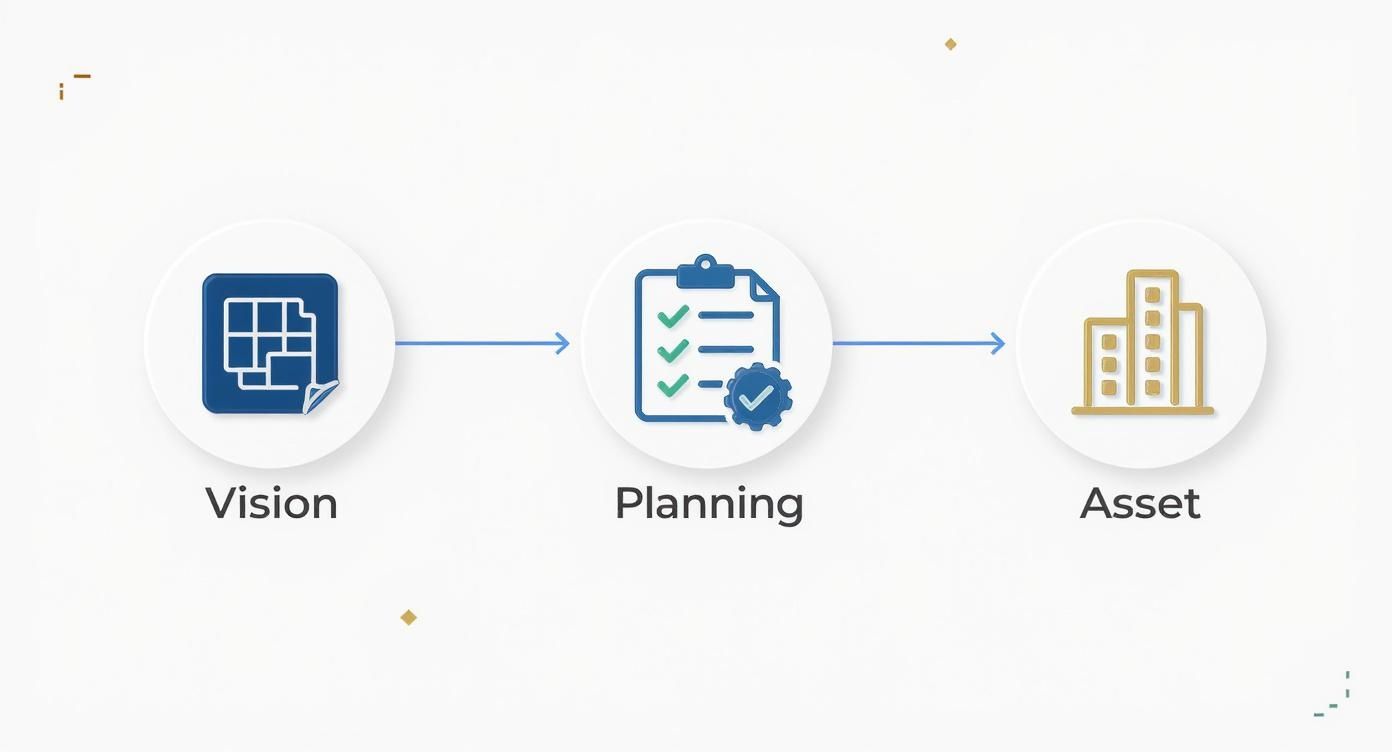
The key takeaway here is that the quality of the final asset is directly tied to how well the planning stage is executed. Let’s break down the five phases that make this happen.
Phase 1: Feasibility and Conception
This is the all-important "should we even do this?" stage. Before a single dirham is spent on design or a shovel hits the ground, the project idea is put under a microscope. The goal is simple: confirm that the project is viable from every angle—financially, legally, and practically.
Key activities here include:
Market Analysis: Is there real demand? What are competitors doing? What price will the market bear?
Financial Modelling: Running the numbers to project costs, potential revenues, and overall profitability.
Site Evaluation: Looking at the land itself. What are its benefits and constraints?
For our beachfront project in Dubai, this means confirming that a market for luxury villas actually exists, that projected sales prices will cover the sky-high land and construction costs, and that local zoning laws allow for the design we have in mind. The critical output is a bulletproof feasibility study—the ultimate go/no-go signal for investors. To dig deeper into this, have a look at our smart project planning guide on feasibility studies in Dubai.
Phase 2: Design and Engineering
Once the project gets the green light, it’s time to turn the vision into a technical reality. This is where architects and engineers step in, translating the concepts from the feasibility study into detailed, buildable plans. The objective is to produce a complete set of blueprints that leave nothing to interpretation.
This phase is about more than just aesthetics. It’s about function, safety, and strict compliance with local building codes, like those enforced by the Dubai Municipality. Every single detail, from the structural supports in the foundation to the layout of the electrical wiring, is meticulously defined. The final architectural and engineering drawings are the key deliverable.
Phase 3: Procurement and Tendering
With a detailed design locked in, the next step is to assemble the team that will actually build the project. The procurement phase is all about finding, vetting, and hiring the main contractor, as well as key subcontractors and suppliers.
This is a strategic exercise, not just a race to the bottom on price. For a high-end development in Dubai, you’d be looking for contractors with a proven portfolio of luxury projects and the financial stability to see a demanding project through to completion.
The core objective of tendering is to create a competitive environment that delivers not just the best price, but the best value. This means weighing a contractor's experience, safety record, and ability to stick to the schedule.
The process ends with the signing of legally binding contracts. These documents are crucial—they lock in costs, timelines, and quality standards before the serious spending begins.
Phase 4: Construction and Execution
This is where the project comes to life. It's the most visible and often the longest phase, where the physical asset finally takes shape on site. The project plan evolves from a theoretical document into a day-to-day management tool.
The project manager's focus narrows to three things: monitoring progress against the schedule, controlling costs against the budget, and ensuring every aspect of the build meets the required quality standards. This means constant site inspections, regular progress meetings, and clear reporting to all stakeholders. For our beachfront property, this covers everything from pouring the foundation to installing the bespoke Italian marble in the lobby.
Phase 5: Handover and Closeout
The final sprint is all about ensuring a smooth transition from a construction site to an operational asset. This involves final inspections, commissioning all the building’s systems (like HVAC, fire safety, and elevators), and fixing any minor defects identified during the final "snagging" process.
A project isn’t truly finished until all the paperwork is in order. This means compiling and handing over a complete package of documentation, including as-built drawings, equipment warranties, and operations manuals. For a residential tower, this phase ends when the keys are handed to the new owners and the building’s management is transferred to the owners' association, officially marking the end of the development journey.
Here's a table that neatly summarises the journey from an idea to a finished asset.
Key Activities and Deliverables Across Project Planning Phases
Phase | Primary Goal | Key Activities | Critical Deliverable |
|---|---|---|---|
1. Feasibility & Conception | Validate project viability | Market analysis, financial modelling, site evaluation, risk assessment | Comprehensive Feasibility Study |
2. Design & Engineering | Translate vision into technical plans | Architectural design, structural engineering, MEP (Mechanical, Electrical, Plumbing) planning, regulatory approvals | Finalised Construction Drawings & Permits |
3. Procurement & Tendering | Secure the right construction team and suppliers | Prequalification of contractors, tender package preparation, bid evaluation, contract negotiation | Signed Construction Contracts |
4. Construction & Execution | Build the asset according to plan | Site mobilisation, physical construction, quality control, schedule & budget monitoring | Physically Completed Asset |
5. Handover & Closeout | Transition the asset to operational status | System commissioning, defect rectification (snagging), final inspections, documentation handover | Handover Package & Project Completion Certificate |
This phased approach provides the control and foresight needed to navigate the complexities of real estate development successfully.
Essential Tools for Modern Project Planners
Trying to manage a major development project without the right tools is like navigating a ship without a compass. You might have a destination in mind, but you have no real way to chart the course. In modern project planning, a specific set of tools and techniques brings much-needed clarity and control, turning a chaotic jumble of tasks into a structured, actionable plan.

Getting to grips with these instruments is what separates a basic to-do list from a powerful strategic asset. They give you the foresight to manage the thousands of moving parts in a real estate project, ensuring every decision is driven by data, not just gut feeling.
Deconstructing Complexity with a Work Breakdown Structure
Before you can schedule anything, you first have to understand everything that needs to be done. That’s the entire point of a Work Breakdown Structure (WBS). Think of it as a detailed recipe. You wouldn’t just write "build a villa"; you'd break it down into every single step, from laying the foundation and framing the walls to fitting the windows and painting the trim.
A WBS applies this exact logic to a high-rise tower or a sprawling community. It takes the final, massive deliverable—the finished building—and breaks it down into smaller, more manageable parts. These parts are then broken down even further into individual work packages and tasks.
This hierarchical approach is fundamental because it ensures nothing gets missed. It creates a comprehensive inventory of all the work required, which then becomes the bedrock for everything that follows, from estimating costs to building out the project schedule.
Visualising the Timeline with Gantt Charts
Once you have that detailed list of tasks from your WBS, the next job is to map them out over time. This is where the Gantt chart shines. If the WBS is your project's recipe, the Gantt chart is its GPS—a clear, visual roadmap showing the entire journey from start to finish.
A Gantt chart is a simple-looking but incredibly powerful horizontal bar chart that maps out the project schedule. Each bar represents a task, and its length shows how long that task will take. At a glance, it shows you:
Task Start and End Dates: Exactly when each activity is set to begin and conclude.
Task Dependencies: How tasks are linked, showing which jobs must finish before others can even start.
Project Milestones: Key deadlines and deliverables are clearly marked for easy tracking.
Overall Progress: You can instantly see what’s on track, what’s falling behind, and what’s coming up next.
This visual clarity makes it an essential tool for communicating the schedule to stakeholders and keeping the entire team pulling in the same direction.
The Critical Path Method isn't just a scheduling technique; it's a strategic tool. It forces you to identify the absolute-priority tasks that define your project's minimum completion time, allowing you to focus your resources where they matter most.
A key technique used with Gantt charts is the Critical Path Method (CPM). It identifies the longest sequence of dependent tasks that directly impacts the project's completion date. Any delay to a task on this "critical path" will push back the entire project's finish line, making it the absolute focus for management. While many firms manage this in-house, partnering with one of the top project management companies in Dubai can bring in specialised expertise for complex scheduling challenges.
Modern Tools for Proactive Management
Beyond the basics of scheduling, today’s planning incorporates tools designed to manage projects proactively, not reactively. A Risk Register, for example, is your project’s "what-if" playbook. It’s a live document where you identify potential risks, assess their likelihood and impact, and map out a pre-planned response to deal with them before they derail your progress.
Another game-changer is Building Information Modelling (BIM), now a cornerstone of planning in asset development. BIM is so much more than a 3D model; it's the creation of a complete digital twin of the asset. This virtual version allows teams to "build" the project on a computer before a single dirham is spent on site. This helps spot design clashes, optimise materials, and simulate the construction sequence, drastically cutting down on errors and expensive rework later on.
Mastering Cost and Schedule Management
In real estate development, the old saying "time is money" isn't a cliché—it's the absolute truth. A single week's delay can trigger a domino effect of financial consequences, while one overlooked expense can steadily chip away at your profit margin. This is why mastering the twin disciplines of cost and schedule management isn't just a 'nice to have'; it's the very heart of successful project planning.
Getting these forecasts right is both an art and a science, especially in a market that never sits still. In the early days of a project, during feasibility studies, you'll often start with high-level analogous estimates. Think of it as educated guesswork based on past experience. For instance, if a similar beachfront villa cost AED 15 million to build last year, you have a rough, back-of-the-napkin starting point for a new one.
But as the project moves from a concept into detailed design, that broad-brush approach just won't cut it. You need precision.

Building a Defensible Budget
This is where you roll up your sleeves and get into granular, bottom-up estimating. Using the Work Breakdown Structure (WBS) we talked about earlier, every single task—from the first shovel in the ground to the final coat of paint—is priced out individually. This methodical process doesn't just give you a number; it builds an accurate and defensible budget you can stand behind.
Of course, managing the money is only half the battle. You also need a rock-solid schedule. It's worth exploring some of the 10 Essential Project Scheduling Techniques to see how modern methods give you tighter control over your timelines. Remember, this level of accuracy is critical for securing financing—lenders will pore over these figures with a fine-toothed comb.
A project budget isn't just a list of expenses; it's a financial roadmap. A well-built budget anticipates challenges, includes sensible buffers for the unknown, and provides a clear benchmark for measuring performance throughout the project's lifecycle.
Guarding Against Common Threats
Even the most meticulously crafted plans will face turbulence. The real difference between a successful project and a cautionary tale is how proactively you identify and manage these risks. The usual suspects include:
Scope Creep: The slow, unmanaged trickle of new requirements that seem small on their own but collectively add significant cost and time.
Unrealistic Deadlines: Timelines pushed from the top down that simply don't align with the on-the-ground reality of the work involved.
Inadequate Contingency: The failure to build in a sufficient financial cushion—typically 5-10% of the total budget—to handle unexpected problems.
Keeping these threats at bay requires a disciplined change control process and radically transparent communication. This is especially vital in the GCC, a region awash with massive capital investment. The total pipeline of announced projects across MENA is estimated at a staggering USD 3.7 trillion, and with 97.6% of industry experts forecasting revenue growth for 2025, the stakes have never been higher. Rigorous control is non-negotiable.
This kind of financial scrutiny is a cornerstone of any formal evaluation. To get a better sense of how investors and lenders approach this, our guide on financial due diligence in Dubai shows exactly how these processes intersect with project planning.
At the end of the day, cost and schedule are two sides of the same coin. A delay in securing a critical material brings work to a standstill, which drives up labour costs and can even trigger contractual penalties. By constantly connecting the dots between your schedule and your budget through regular reviews, you can steer your project towards a profitable finish line.
Navigating UAE and Oman Regulatory Frameworks
Getting a real estate project off the ground in the Gulf takes more than just construction know-how. You have to be incredibly sharp when navigating the specific legal and financial landscapes of the region. This is where meticulous project planning becomes your most valuable asset—it’s not just about tracking timelines and materials, but the very foundation of your compliance strategy in the UAE and Oman.
Think of your project plan as the central piece of evidence for your entire venture. When you're looking for financing, lenders aren't just buying into a vision; they're investing in a documented, credible strategy. A thorough plan, packed with detailed costings, schedules, and risk assessments, signals professionalism. It takes the guesswork out for them, making it a non-negotiable part of any successful due diligence process.
This reality plays out against a backdrop of massive state-led investment. In 2024, public entities drove 74.7% of infrastructure spending, but private sector involvement is picking up serious momentum. To tap into this growing pool of private capital, you need a plan that's solid as a rock. You can get a better sense of these trends by looking into the Middle East's construction market dynamics.
Linking Planning to Legal Agreements
Every detail you bake into your project plan has real, legally binding consequences, especially when it comes to Property Purchase Agreements (PPAs). These contracts aren’t just drafted out of thin air; they are built directly on the timelines and deliverables you’ve already committed to in your plan.
For example, the handover date you promise in a PPA comes straight from your project schedule's critical path. If that schedule is off, even by a little, you could be facing serious legal and financial penalties for delays. A well-thought-out plan ensures the promises you make in your legal documents are actually achievable.
This need for detail doesn't stop at the initial sale. Understanding local regulations is absolutely critical for the long run. Take a look at our guide on Abu Dhabi's tenancy law to see just how deeply these legal frameworks affect asset management long after the construction crews have packed up.
The Critical Role of Reserve Fund Studies
In the UAE, the Reserve Fund Study is a perfect example of where project planning and regulatory compliance meet. This isn't some optional add-on; it's a legal requirement designed to protect the long-term financial health and upkeep of a development.
A Reserve Fund Study is essentially a financial forecast. It maps out the long-term costs of repairing and replacing a building's major shared assets over its entire life. We're talking about big-ticket items like:
HVAC systems
Elevators
Roofing materials
Façade cleaning equipment
The reliability of this study hinges completely on the quality of information that came out of the planning and construction phases. Your detailed plans, material specifications, and asset data sheets are the raw ingredients for an accurate forecast. Without that solid foundation, the study becomes pure guesswork, which can lead to underfunded reserves and, inevitably, legal battles with property owners down the line.
A meticulously documented project plan is your first and best line of defence in the world of real estate law and finance. It provides the verifiable data needed to secure funding, draft enforceable contracts, and satisfy long-term regulatory obligations.
At the end of the day, it's clear that the practical, on-the-ground work of project planning is deeply connected to the high-stakes world of regional real estate finance and law. The diligence you put into planning the build directly translates into legal and financial resilience for the asset's entire lifecycle. It turns your project plan from a simple operational tool into an essential instrument of governance and compliance.
A brilliant plan without proper oversight is just a document gathering dust. That's why effective project planning doesn't stop once the blueprints are approved; it needs a solid governance structure to keep it alive and on track. Think of governance as the project's central nervous system, making sure every moving part—from contractors to investors—is aligned and accountable right through to handover.
Good governance is more than just asking, "Are we on time and on budget?" It pushes for a smarter, more nuanced way to measure success using the right Key Performance Indicators (KPIs). Cost and schedule are crucial, of course, but they only tell part of the story.
Defining What Truly Matters with KPIs
To get a real feel for a project's health, your governance model needs to track a balanced mix of metrics. These KPIs give you hard data, allowing you to make decisions based on facts, not just gut feelings. A solid project dashboard should always include:
Quality Standards: Are we hitting our material specifications? What are the defect rates? This ensures the final asset is actually built to the standard you promised.
Safety Metrics: Tracking incident rates is non-negotiable. It's about protecting your people and your bottom line from liability.
Stakeholder Satisfaction: How do investors, clients, and the local community feel about the project? Their buy-in is critical for a smooth ride and future opportunities.
Budget Variance: This is a simple but powerful one: planned spend versus actual costs. Catching deviations early can save a project from financial trouble.
Together, these indicators give you a 360-degree view, making sure you’re not sacrificing quality or safety just to hit a deadline or save a few dirhams.
The Role of a Project Management Office
For developers juggling multiple projects, a Project Management Office (PMO) can be a game-changer. A PMO doesn’t run the day-to-day of each project. Instead, it acts as a central command, providing the tools, templates, and oversight to ensure consistency and high standards across your entire portfolio. It’s the guardian of your organisation's best practices.
A PMO transforms project management from an isolated discipline into a strategic, enterprise-wide capability. It ensures that lessons learned from one project become standard procedure for the next.
This kind of centralised control is what drives real efficiency and makes your outcomes far more predictable.
Best Practices for the Regional Context
In fast-paced markets like the UAE and Oman, a rigid, "set-it-and-forget-it" plan is doomed to fail. Here, effective governance has to be agile and built on communication. A massive part of this is Mastering Risk Management in Project Management, which gives you the toolkit to anticipate and handle the unique challenges of the region.
A few best practices are essential here. First, maintain incredibly transparent communication with everyone involved, from your main contractor right down to the municipal authorities. Second, be ready to adapt your plan when market conditions shift or unexpected site issues pop up—because they will.
Finally, always conduct a thorough post-project review. This process turns every development, whether it went perfectly or hit a few bumps, into a powerful learning experience. It’s how you continuously refine your planning process for every asset you build in the future.
Frequently Asked Questions About Project Planning
Even with the best guide in hand, putting project planning principles into practice in the real estate world always brings up a few questions. Let's tackle some of the most common ones we hear from developers and investors across the UAE and Oman to clear up any confusion.
How Does Planning Differ for Small Versus Large Projects?
So, how different is planning a small residential building compared to a massive mixed-use development? The core ideas—scope, schedule, cost—are the same, but that’s where the similarities end. The scale and complexity are worlds apart.
For that small residential building, you might have a tight-knit team running the show with some straightforward tools. A simple Gantt chart and a well-organised spreadsheet can often get the job done perfectly.
Now, picture a sprawling mixed-use project. It’s a different beast entirely. You’ll need a much more sophisticated setup: a dedicated Project Management Office (PMO), advanced software like Building Information Modelling (BIM) and tools for Critical Path Method (CPM) analysis, not to mention a meticulous strategy for handling all the stakeholders and government approvals. The risk is also massively higher, calling for detailed risk registers and a hefty contingency fund.
What Is the Biggest Mistake to Avoid in the UAE?
If there's one pitfall to sidestep when planning a project in the UAE, what is it? Hands down, it's underestimating the regulatory and approvals process. This is a common and incredibly costly mistake.
The UAE’s approval system is rigorous and multi-layered, involving various authorities like the Dubai Municipality, RERA, and DEWA. Any project plan that doesn’t bake in enough time and resources to navigate this labyrinth is almost guaranteed to hit major delays and budget blowouts.
The key is to start talking to these authorities early. Their timelines and very specific requirements need to be woven directly into the critical path of your project schedule from day one—not just tacked on as an afterthought.
How Can Technology Improve Project Planning?
Where do technology and AI fit into modern construction project planning? They are completely changing the game, bringing a new level of accuracy and efficiency to the table.
For instance, AI-driven software can sift through data from past projects to produce far more dependable cost and time estimates, taking a lot of the guesswork out of the equation. BIM allows us to build a detailed 3D digital version of the project first. This lets teams spot design clashes and run construction simulations before a single shovel hits the ground, saving a fortune in rework and delays.
On top of that, we now use tools like drones for incredibly precise site surveys and to keep a constant eye on progress, feeding live data straight back into the project plan. All this tech boosts precision, helps teams work together seamlessly, and gives project managers the hard data they need to make smarter decisions, faster.
At the end of the day, solid project planning is what separates a successful real estate venture from a cautionary tale. It’s the bedrock of everything from the initial valuation to the final handover. At Credence & Co., we bring the expert advisory and valuation services you need to make sure your projects are built on that solid foundation.


Comments