%20file.png)

Your Guide to Buy Business Assets in the UAE and Oman
- Credence & Co.

- Dec 15, 2025
- 17 min read
Updated: Apr 27
Taking the leap to buy a business is one of the most powerful wealth-building moves you can make. It's a direct route to entrepreneurship, but with a crucial head start: an established foundation. In fast-paced markets like the UAE and Oman, you’re not just acquiring assets; you’re stepping into immediate market presence and ready-made cash flow.
Your Gulf Business Ownership Journey Begins Here

Think of this guide as your map for navigating a company acquisition in the dynamic economies of the UAE and Oman. Becoming a business owner here is so much more than a financial transaction. It's a strategic play to bring your entrepreneurial vision to life in a region buzzing with potential.
We’re going to skip the generic advice. Instead, you’ll get a practical, on-the-ground perspective that’s been honed by real-world deals in these specific markets.
Choosing to buy is a strategic shortcut. You get to sidestep the long, uncertain road of building a company from the ground up. Forget spending years creating a brand, finding customers, and perfecting operations—you inherit a proven model, ready for your unique vision.
Why the UAE and Oman Present Unique Opportunities
The conditions in the Gulf for business acquisitions are incredibly strong right now. Pro-business government initiatives, a determined push to diversify economies beyond oil, and a prime global location make both the UAE and Oman investment hotspots.
Here’s what that means for you in practical terms:
Plug-and-Play Infrastructure: You instantly gain access to established supply chains, a skilled team, and existing physical or digital infrastructure.
Day-One Revenue: Unlike a startup, an existing business generates cash flow from the moment you take over. This stability gives you a solid platform to launch your growth plans.
Built-in Market Validation: You're buying a concept that already works. The product or service has a proven audience, which dramatically cuts your market entry risk.
Easier Access to Finance: Lenders are far more comfortable financing the purchase of an established company with a solid track record than they are backing a new venture.
This isn't about ticking off a rigid checklist. It's about hitting a series of achievable milestones. Each step, from finding the right target to signing the final papers, builds momentum and helps you turn your vision into a reality with absolute confidence.
A Mindset for Success
To successfully close a deal, you need more than just capital. You need a strategic mindset. It's about seeing the untapped potential in an established business and having the foresight to unlock its next chapter of growth.
This guide is designed to help you build that very mindset. If you want to dive deeper into the technical side of these deals, our resources on mergers and acquisitions support offer a closer look at the structured processes. From spotting the right opportunity to integrating your new company, we’re here to light the way forward with clarity and purpose.
How to Find the Right Business Opportunity
Finding the perfect business to buy isn’t about luck. It's about a structured, intelligent search, and it all starts with you. Before you even think about scanning listings, you need absolute clarity on what you want to achieve. This means defining your "buy box"—the non-negotiable criteria a target business must meet.
This goes far deeper than just industry or revenue. What’s your expertise? How hands-on do you want to be? Are you the operator ready to roll up your sleeves and turn around a struggling café, or are you a strategic investor looking for a B2B service firm that already has a solid management team in place?
Knowing your exact criteria is your most powerful filter. It will save you countless hours chasing deals that were never right and focus your energy where it truly matters.
Actively Sourcing Your Next Venture
With a clear buy box, you can stop being a passive observer and become an active hunter. The best opportunities, especially in the UAE and Omani markets, are rarely advertised. You need to tap into a mix of channels to find those hidden gems.
Business Brokers and M&A Advisors: Think of these specialists as your frontline troops. They have deep networks and access to sellers who need confidentiality. A great advisor won't just flood you with listings; they'll get to know your goals and actively hunt for deals that fit your mandate.
Professional Networks: Your own contacts are pure gold. Talk to your lawyer, your accountant, and your peers in the industry. Get out there and attend events hosted by the local chambers of commerce in Dubai or Muscat. You'd be surprised how often a casual chat can lead to a direct introduction to a business owner quietly thinking about their exit.
Online Marketplaces: Platforms like Flippa or local business-for-sale sites can be a good starting point for smaller acquisitions or just to get a feel for market prices. Just be ready to do some serious digging, as the quality of information can be all over the place.
The most valuable deals often come from proprietary sourcing—finding opportunities that no one else knows are for sale. This proactive approach gives you a massive advantage in negotiation and reduces competitive pressure.
Interpreting the Initial Approach
Once you’ve identified a potential target, the first thing you'll likely receive is a Confidential Information Memorandum (CIM). This is the seller's opening pitch—an overview of the business, its operations, and its top-line financials.
Think of the CIM as a detailed CV for the company. Your first job is to run a quick, critical analysis. Don't get bogged down in the details just yet. The goal is simple: validate the opportunity against your buy box.
Making the First Cut
This preliminary review has to be swift and decisive. You're searching for compelling reasons to keep going or clear red flags that tell you to walk away. This initial screen is absolutely essential for using your time wisely.
Ask yourself these questions right away:
Financial Alignment: Do the revenue and profit numbers hit your minimum targets?
Strategic Fit: Is this a sector you genuinely understand and believe in?
Growth Story: Can you see a clear, believable path to growth, or has the business flatlined?
Obvious Risks: Are there any immediate deal-breakers, like 90% of revenue coming from one client or a major regulatory change on the horizon?
For those wanting to get ahead of the curve, it's worth understanding the modern tools of the trade; the use of alternative data in private equity sourcing is changing how savvy investors identify prime targets. And if you're zeroing in on a specific commercial hub, having the right contacts is everything. Our guide on the leading resources for Business Bay Dubai companies can give you a powerful head start.
This disciplined approach ensures you only invest your time, money, and energy into opportunities with a real shot at success.
Mastering Valuation and Financial Due Diligence
So, you’ve found a business that looks promising. Now comes the hard part—the real analytical work. Figuring out what a company is truly worth is a delicate dance between cold, hard numbers and the subjective potential of its future. This is where the dream of buying a business gets real, fast.
You have to look past the seller’s asking price. That number is often tied to emotion or overly optimistic forecasts. Your job is to build a valuation from the ground up, one that’s firmly rooted in the financial realities of the UAE and Omani markets.
The Three Pillars of Business Valuation
There’s no single magic formula for valuing a business. Instead, we look at it from a few different angles to arrive at a fair market value range. Each approach tells a different part of the company's story.
Enterprise Value (EV) via EBITDA Multiples: This is the go-to method for most established, profitable businesses. You take the company's Earnings Before Interest, Taxes, Depreciation, and Amortisation (EBITDA) and apply a multiplier that’s typical for its industry, size, and location. For instance, a sought-after SaaS company in Dubai might fetch a 7-10x multiple, while a traditional local retail business could be closer to 3-4x.
Asset-Based Valuation: This one is more straightforward. It’s often used for businesses whose value is tied up in physical things, like a manufacturing plant or a company holding a lot of real estate. You simply calculate the net value of all assets (machinery, property, stock) and subtract the liabilities. It gives you a solid "floor" price but can miss the intangible value of things like brand reputation or a loyal customer base.
Purchase Price Allocation (PPA): While this is technically an accounting task you do after the acquisition, thinking about it early is crucial for negotiations. PPA is about assigning the price you pay to all the different assets you’re acquiring—both tangible and intangible (like goodwill). Getting a sense of this upfront helps you understand how the deal will look on your books down the line.
The journey to finding a business worth valuing is just as important. The way you source a deal can significantly influence its quality.
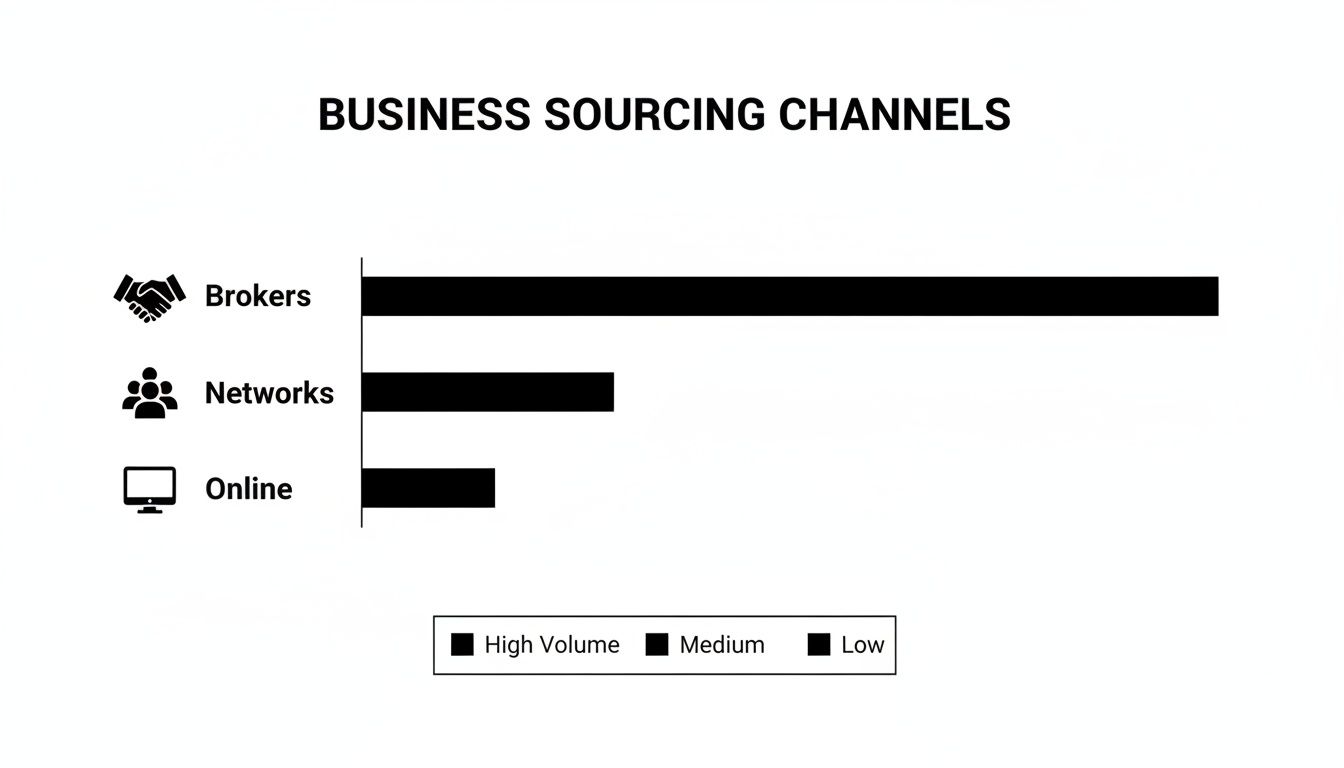
As you can see, while online portals cast a wide net, the real gems often come from specialised brokers and your own personal network—those coveted off-market opportunities.
Key Valuation Metrics Across Booming UAE Sectors
To put the EBITDA multiple approach into perspective, it's helpful to see how different sectors are currently valued in the dynamic UAE market. The table below offers a glimpse into typical valuation ranges and the key factors that drive them.
Sector | Typical EBITDA Multiple Range | Key Valuation Drivers |
|---|---|---|
Technology (SaaS/FinTech) | 8x – 15x+ | Recurring revenue (MRR/ARR), customer acquisition cost (CAC), churn rate, scalability. |
Healthcare & Pharma | 7x – 12x | Regulatory approvals, patient base, intellectual property, insurance network agreements. |
F&B and Hospitality | 4x – 8x | Brand recognition, location, footfall, supply chain efficiency, franchise agreements. |
Logistics & E-commerce | 5x – 9x | Fleet size and condition, warehouse technology, delivery network reach, key client contracts. |
Real Estate Brokerage | 3x – 6x | Agent network size, commission structures, market share, brand reputation, property portal presence. |
These figures are a starting point, not a final answer. A thorough valuation will always dig deeper into the specifics of the individual business.
Diving Deep with Financial Due Diligence
Valuation gives you a number; due diligence tells you if that number is built on solid ground. This is where you roll up your sleeves and conduct an exhaustive investigation into the company’s financial health. It’s about verifying what the seller has told you and, just as importantly, uncovering what they haven’t.
Financial due diligence isn't about finding reasons to walk away. It's about getting all the facts on the table so you can say "yes" with total confidence—at the right price and on the right terms.
You have to be meticulous here. This is your shield against expensive surprises popping up after the ink is dry. To get a sense of the disciplined approach required, check out a practical guide to private equity due diligence.
A proper investigation goes way beyond a quick look at the profit and loss statements. You need to examine every financial nook and cranny. Bringing in experts for this stage isn't just a good idea; it's essential. You can learn more about how our team tackles this critical phase in our overview of our financial due diligence services in Dubai.
Your Essential Due Diligence Checklist
To make sure nothing slips through the cracks, it helps to organise your investigation into a few key areas. This structured approach helps build a complete, unvarnished picture of the company’s finances.
1. Quality of Earnings Analysis
The goal here is simple: find the business’s true, repeatable cash flow. That means adjusting the reported EBITDA by stripping out any one-off expenses, non-recurring revenue, or personal owner perks being run through the books. Ask yourself:
Are there unusually large sales booked right at the end of a quarter to puff up the numbers?
Did the owner prepay a bunch of expenses to make profits look healthier than they are?
Are there significant "add-backs" that don't truly reflect the day-to-day cost of running the business?
2. Balance Sheet Scrutiny
The balance sheet is a snapshot of financial health. Your job is to make sure it's not a doctored photo.
Accounts Receivable: How old are the unpaid invoices? If a big chunk of them are over 90 days old, that’s a massive red flag for collection issues.
Inventory: Is the stock valued correctly on the books? Is any of it obsolete or gathering dust? Sometimes, you just need to go and see it for yourself.
Unrecorded Liabilities: This is where the skeletons hide. You need to actively hunt for potential liabilities that aren't on the books—think pending lawsuits, unresolved tax disputes, or the significant end-of-service gratuity obligations for employees here in the UAE.
3. Working Capital Assessment
Getting a handle on the company's working capital cycle is vital for managing cash flow the day you take over. A seller might try to pretty things up by delaying payments to suppliers or running down inventory just before the sale. This makes the working capital needs look artificially low, leaving you with a sudden cash shortfall right after closing. The key is to calculate a normalised level of working capital needed to run the business without any drama.
This kind of rigorous financial deep-dive ensures the price you pay is based on fact, not fiction. It’s what gives you the power to negotiate from a position of strength and build a deal that sets your new venture up for success from day one.
Diving into the Legal and Regulatory Maze
Alright, you've crunched the numbers and the deal looks promising on paper. Now comes the part where we make sure it's built on solid ground. A successful acquisition isn't just about the bottom line; it's about making sure the whole thing is legally sound and compliant. Stepping into the legal world of the UAE and Oman can feel like navigating a maze, but think of it as a roadmap to securing your investment.
This isn't just a box-ticking exercise. It's a deep, investigative dive to uncover any skeletons in the closet, verify everything the seller has told you, and ensure you're not walking into a legal hornet's nest. From corporate documents and trade licences to employee contracts and hidden disputes, every single detail matters. Skipping this step is a high-stakes gamble you simply can't afford to take.
The Heart of Legal Due Diligence
Your legal investigation needs to be systematic and relentless. The mission is to get a crystal-clear picture of the company's legal health and pinpoint any liabilities that could poison the deal or hamstring you later on. This goes way beyond glancing at a few contracts; it's about piecing together the entire legal puzzle.
Here’s what your essential checklist should look like:
Corporate Records: Are the company’s foundational documents—articles of association, shareholder agreements, board minutes—all present and accounted for? This is how you confirm the seller actually has the authority to sell.
Commercial Licences: Is the trade licence up-to-date, and does it cover all the business's current activities? Operating outside the scope of your licence in the UAE or Oman can bring down some serious penalties.
Contracts and Agreements: It's time to get forensic. Scour every significant contract with suppliers, key customers, and landlords. You're hunting for things like change-of-control clauses that could be triggered the moment you take over.
Employment Contracts: Get a firm handle on all employee agreements. You need to understand your obligations, especially around end-of-service gratuity—a major liability in the Gulf that can catch newcomers by surprise.
Litigation and Disputes: Is the company tangled up in any current or potential lawsuits? A clean bill of legal health is an incredibly valuable asset.
Keeping Pace with Key Regulatory Shifts
The regulatory ground in the UAE and Oman is always shifting, mostly in ways designed to welcome foreign investment. One of the biggest game-changers has been the UAE's move toward allowing 100% foreign ownership for many onshore businesses, finally breaking away from the old local sponsor requirement.
But don't assume this applies everywhere. This liberalisation isn't a blanket policy, and certain strategic sectors still have ownership restrictions. It is absolutely critical to confirm whether the industry you're buying into allows full foreign ownership or if you'll still need to navigate a partnership structure. Getting this wrong can stop a deal dead in its tracks.
This isn't just about following rules; it's a strategic imperative. Understanding the subtle but crucial differences between operating on the mainland versus in a free zone will fundamentally shape your deal's legal structure and how much freedom you have after you take the keys.
Getting Smart About Tax and VAT
Tax compliance has become another non-negotiable part of due diligence. With the introduction of Value Added Tax (VAT) in 2018 and Corporate Tax in 2023, the financial landscape in the UAE has become far more complex.
Your investigation has to include a thorough review of the target company’s tax history. This means verifying that all VAT returns were filed correctly and that the business is fully prepared for the 9% corporate tax regime. Any past mistakes or oversights will become your problem the day the deal closes, potentially leading to some nasty surprises from the Federal Tax Authority (FTA).
The current economic climate makes this even more critical. For example, the UAE's real estate market is on fire. In 2024, property transactions hit a staggering AED 522.5 billion, a 27.2% jump from the previous year, fueled by foreign capital. This boom, combined with the new tax laws, means anyone buying a business in construction or property management needs to be exceptionally diligent. You can get a deeper sense of these trends from the latest MENA economic review.
Getting the Final Green Light
Finally, no deal is done until the relevant authorities say it's done. The process for getting these approvals can vary wildly depending on the jurisdiction and the type of business.
In mainland Dubai, for example, your main point of contact will be the Department of Economic Development (DED). But if the business is in a free zone like Jebel Ali Free Zone (Jafza) or the Dubai International Financial Centre (DIFC), you'll have to play by their specific rulebooks for share transfers and licence amendments.
Here's a simple, practical way to approach it:
Map out all required approvals right at the beginning.
Prepare all your documentation with painstaking care.
Engage with the authorities early and proactively to get ahead of any questions.
Tackling the legal and regulatory review in this structured way does more than just protect your investment—it paves the way for a smooth, clean transition. It turns what could be a field of legal landmines into a clear, manageable path, ensuring your new venture gets off to the strongest possible start.
From Negotiation to a Successful Close

This is it. The moment all your intense research and careful diligence finally comes to fruition. Now, you switch gears from investigator to negotiator. It’s a critical shift where your strategy, communication skills, and a firm grasp of your non-negotiables become your greatest strengths. Remember, the goal isn't just to chip away at the price; it's to build a deal that sets you up for success long after the ink has dried.
True negotiation is about finding that sweet spot where both sides feel they've won. You need to get inside the seller's head. Are they retiring and looking for a legacy? Launching a new venture? Or are they feeling the pressure? Understanding their motives helps you shape your offer in a way that resonates with them while fiercely protecting your own bottom line.
Think beyond the big number. An earn-out clause, for example, is a brilliant tool to bridge a valuation gap. By tying part of the payment to future performance, you show your belief in the business's potential while protecting yourself if those ambitious projections don’t quite pan out.
Mastering the Art of Negotiation
Everything you uncovered during due diligence is now your negotiating toolkit. Unrecorded liabilities? Overstated inventory? These aren't just red flags; they are hard, data-backed realities that need to be factored into the final price.
Bring these points to the table constructively, not confrontationally. Frame it as a collaborative effort to adjust the price based on new, verified information. It's about fairness, not fault.
The heart of the negotiation will always circle back to a few key areas:
The Final Purchase Price: The definitive number, adjusted based on what you found.
Payment Structure: How will you pay? Upfront cash, seller financing, an earn-out, or a mix of all three.
Working Capital Peg: Nail down the exact amount of working capital that must be in the business at closing. This prevents any nasty surprises.
Warranties and Indemnities: These are the seller's promises about the business and their legal agreement to cover your losses if those promises turn out to be false.
The greatest power you have in any negotiation is the willingness to walk away. When you are truly prepared to say "no" to a deal that doesn't meet your essential criteria, you ensure you only move forward on terms that make absolute sense for you.
Decoding the Sale and Purchase Agreement
The Sale and Purchase Agreement (SPA) is where your handshake deal becomes a legally binding reality. This document is exhaustive for a reason—it leaves zero room for misinterpretation. While your legal team will do the heavy lifting, you need to understand every component to be certain it mirrors the agreement you struck.
A solid SPA is your ultimate safety net, spelling out every single term, condition, and responsibility. Getting this right is absolutely crucial, as a single poorly worded clause can have massive financial consequences later on. For first-timers, this stage is full of pitfalls; it’s worth reviewing the common mistakes to avoid when acquiring a business to gain some valuable perspective.
This is particularly relevant in booming sectors. In the UAE, for instance, the commercial construction sector shot up by 6.6% in 2024, with infrastructure not far behind at 5.9%. Acquiring a pre-qualified firm in this arena could be a masterstroke, giving you a piece of the USD 38.77 billion in project awards. For a closer look at these trends, you can explore the latest MENA regional economic review.
Your Pre-Closing Checklist
Once the SPA is signed, you're in the home stretch. This final phase is all about ticking off the 'conditions precedent' listed in the agreement. A methodical, organised approach here is essential to avoid last-minute chaos.
Think of your closing checklist as your roadmap to the finish line. It must include:
Final Approvals: Securing the last green lights from regulatory bodies like the Department of Economic Development (DED) or the relevant free zone authority.
Financial Arrangements: Confirming your acquisition funds are locked, loaded, and ready for transfer on closing day.
Third-Party Consents: Getting the necessary sign-offs from landlords, key suppliers, or major clients whose contracts require it.
Document Preparation: Gathering all the final transfer documents, from new share certificates to updated corporate records.
This last stage is a game of precision. By methodically working through each item, you ensure that when closing day arrives, the transfer of ownership is smooth, organised, and the triumphant end to your acquisition journey.
Clearing Up Your Biggest Questions About Buying a Business
Stepping into the world of business acquisition is an exciting move, but let's be honest—it also brings a flood of questions. That’s completely normal. Getting clear, practical answers is what turns that initial uncertainty into the confidence you need to make a smart decision.
Let's dive into the questions we hear most often from entrepreneurs looking to buy in the UAE and Oman.
How Do People Actually Pay for a Business?
This is often the first hurdle, and it’s a big one. The good news? It's almost never a simple all-cash transaction. Most successful deals are pieced together with a smart mix of funding.
Think of it as building a capital "stack." Here are the most common building blocks:
Bank Loans: For businesses with a solid track record and tangible assets, local banks are usually the first port of call. They like predictable cash flow.
Seller Financing: This is a fantastic—and often underused—tool. The seller essentially agrees to be your partner for a period, receiving part of the sale price over time. It’s a huge vote of confidence in the business's future and can make a deal happen that otherwise wouldn't.
Your Own Capital & Investors: Dipping into your savings or bringing in partners to share the risk (and the reward) is a common way to fill any funding gaps.
The right blend really depends on your financial position and the specific deal on the table. There's no one-size-fits-all answer.
What’s a Realistic Price to Pay?
Ah, the million-dirham question. While valuation models give you a starting point, the final number is always a dance between negotiation, what the market is doing, and how much strategic value the business holds for you.
To ground yourself in reality, look at what similar businesses are selling for. A quick scan of online marketplaces shows that many established digital businesses, for instance, trade for somewhere between 2x to 3.5x their annual net profit.
But that's just a benchmark. A fast-growing Dubai tech company will naturally command a higher multiple than a traditional retail shop in Muscat. The real skill is looking beyond the headline numbers to see what’s driving the value. For a much deeper look into this, our guide on determining the market value of your business is a must-read.
Your goal isn't to get the 'cheapest' price. It's to pay a 'fair' price for a quality business that fits your vision. A great business at a fair price will always beat a fair business at a great price.
Okay, I Bought It. Now What?
The day you get the keys isn't the finish line; it’s the starting pistol for the next race. The post-acquisition phase—the integration—is where deals are truly won or lost. I've seen too many buyers rush this and undermine all their hard work.
Your first moves should be deliberate and focused. This is about building bridges, not immediately knocking down walls.
First, talk to the team. They are your single most important asset and hold all the institutional knowledge. Reassure them, listen to what they have to say, and share your vision for the future.
Then, just stabilise things. Before you start changing everything, take the time to truly understand the daily rhythms of the business—the customer relationships, the suppliers, the workflows. Your first 90 days are for learning and earning trust, not for causing chaos. A smooth handover honours the legacy you've just bought into and sets the stage for the growth you're planning.
At Credence & Co., we bring the clarity and hands-on guidance needed to move through every stage of an acquisition with confidence. From the first valuation to the final integration plan, our team is here to make sure your investment is built on solid ground. Explore our M&A support services and see how we can help you reach your goals.


Comments