%20file.png)

Your Guide to Middle East Real Estate Dubai
- Credence & Co.

- Dec 14, 2025
- 15 min read
Updated: Apr 27
When you think of Middle East real estate, Dubai is the city that instantly comes to mind. It's the region's epicentre of ambition, a place where innovation and incredible investment potential meet. More than just a city, Dubai represents a unique blend of solid economic stability and visionary growth, making it a globally recognised safe haven for capital. For any savvy investor, this isn't just another location—it's a landscape of immense opportunity.
Begin Your Dubai Real Estate Investment Journey
Welcome to the beating heart of property investment in the Middle East. This guide isn't just about Dubai's futuristic skylines; it's about the thriving ecosystem built for prosperity that lies within. Its real estate market is a dynamic oasis, constantly drawing in global interest thanks to a robust economy, forward-thinking leadership, and a lifestyle that promises both luxury and security.
This is more than a guide to buying property. It’s about making a strategic move in one of the world's most resilient and exciting markets. We've created a clear roadmap to build your confidence, covering every stage from understanding the fundamentals to making your first investment.
A Market of Record-Breaking Momentum
The numbers don't just talk; they shout from the rooftops. Dubai's real estate market recently shattered all previous records, hitting an astonishing total sales value of AED 624.1 billion through November of last year.
That figure represents a massive 49.6% jump from the entire previous year, driven by an unprecedented 197,263 transactions. This isn't just a hot streak; it's a testament to the market's incredible strength.
This kind of momentum doesn't happen by accident. It’s the direct result of smart, strategic planning and an environment that genuinely welcomes international investors. Several key factors are fuelling this success:
Economic Stability: A diverse economy that isn't just reliant on one sector, providing a solid foundation for your assets to appreciate over the long term.
Visionary Leadership: Government initiatives that actively encourage innovation, ensure security, and cultivate an exceptional quality of life.
Global Safe-Haven Status: A hard-earned reputation as a secure place to live and invest, attracting capital from every corner of the globe.
Think of investing in Dubai as planting a tree in the most fertile soil imaginable. The city's world-class infrastructure, clear regulatory framework, and global appeal create the perfect conditions for your investment to grow strong and deliver substantial returns over time.
Whether your goal is steady rental income, significant capital gains, or finding a place to call home, understanding the unique rhythm of this market is your first step. For those exploring financing, take a look at our comprehensive guide to mortgages in Dubai. Consider this guide your definitive resource, built to empower you to invest wisely.
Understanding the Dubai Property Market Dynamics
To really succeed as an investor in Middle East real estate Dubai, you first need to get a feel for the powerful forces shaping the city's property landscape. Think of it less as a market and more as a carefully conducted orchestra. Economic diversification, a steadily growing population, and bold government initiatives all work in concert, creating a symphony of sustained growth.
This isn't a market driven by chance; it’s powered by incredibly strategic, forward-thinking planning. Landmark events like Expo 2020 and the constant roll-out of ambitious new master-planned communities continually breathe new life and demand into the ecosystem. Getting in sync with this rhythm is the first real step towards making an investment that truly sings.
At the very heart of it all is a legal framework designed to welcome the world. The government's proactive and clear-cut approach has turned Dubai into a magnet for international capital, offering the kind of security that builds unshakable confidence.
Freehold Versus Leasehold Ownership
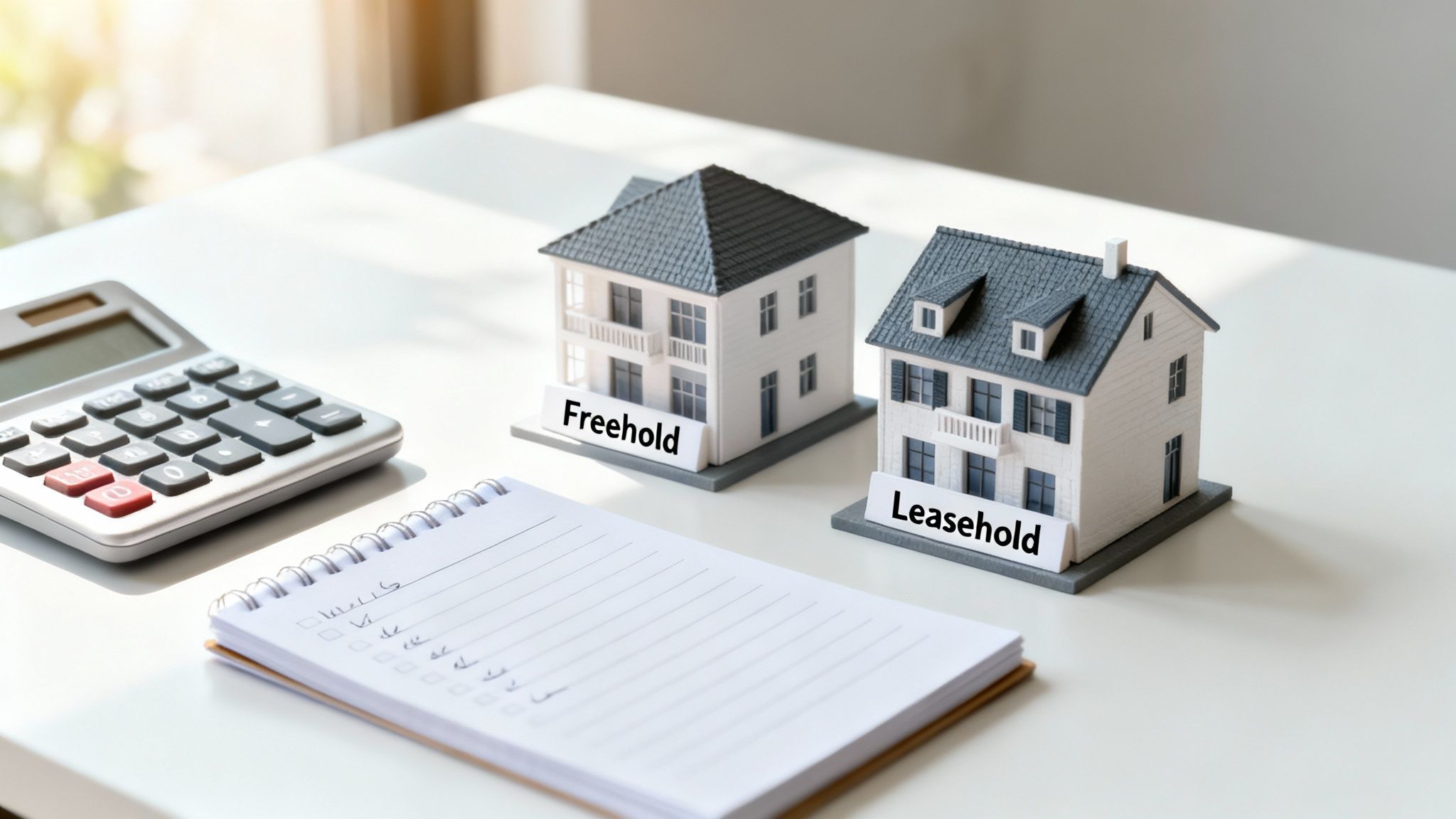
For anyone coming from outside the UAE, the most critical concept to wrap your head around is the difference between freehold and leasehold ownership. This one distinction fundamentally shapes your rights as an owner and the very nature of your investment.
Think of it like this: is it better to own a book outright, or borrow it from a library for a very long time?
Freehold ownership is like owning the book. It grants you absolute, permanent title to the property and the land it sits on. You can sell it, lease it, or pass it down to your heirs without restriction, and your name is officially registered with the Dubai Land Department (DLD). This is, by far, the most popular and desirable option for international buyers in specially designated freehold areas.
On the other hand, leasehold ownership is the long-term loan. It gives you the right to use and occupy a property for a fixed, extended period—typically up to 99 years. While you have control over the property during the lease, you never own the land beneath it. When the term expires, ownership reverts to the original landlord.
Understanding this is fundamental. Freehold offers the ultimate long-term security and the full potential for capital growth, which is why it forms the bedrock of most international investment portfolios in Dubai.
The Pulse of Supply and Demand
Just like any other major global city, Dubai's property market dances to the timeless tune of supply and demand. But here, the rhythm has a unique flavour, driven by a dual-market structure that caters to different investor goals.
The Dubai property market has two main gateways: the off-plan market for those investing in tomorrow, and the secondary market for those who want returns today. Each path offers a distinct set of opportunities designed for different investment horizons.
Figuring out which of these two streams best fits your financial goals is absolutely key.
The Off-Plan Market: This is where you buy a property directly from a developer before it’s even built. The big draw here is the attractive payment plans and lower entry prices, which create massive potential for your property's value to increase by the time it’s handed over. It’s the perfect play for an investor with a long-term vision.
The Secondary Market: This is all about buying existing, completed properties from their current owners. The main advantage is speed and certainty—you can touch the physical asset, and it can start generating rental income almost immediately. This is the go-to for investors who are chasing immediate cash flow.
Ultimately, the delicate balance between new projects hitting the market and the demand from a booming population of expatriates and new residents is what dictates price movements. A good data-driven Dubai real estate market analysis can give you a clearer picture of current trends. This insight is crucial for understanding what moves the needle, and for more on that, our article on the key drivers of Dubai real estate provides a fantastic deep dive.
Finding Your Niche: Dubai's Top Investment Hotspots
Now that we've peeled back the layers of the market, it's time for the exciting part—pinpointing exactly where to invest in Middle East real estate Dubai. Choosing a location is so much more than just picking a spot on a map. It’s about matching the unique soul of a neighbourhood with your own investment goals. Think of Dubai as a stunning mosaic of communities, each telling its own story and holding its own unique promise.
You're like a curator, searching for that perfect piece to add to your collection. Some areas are the timeless classics, delivering prestige and rock-solid returns year after year. Others are the bold, up-and-coming artists, buzzing with the potential for explosive growth. Let's take a tour of Dubai’s most compelling districts to find the one that speaks to you.
The Icons: Where Luxury Meets Global Prestige
For investors chasing the absolute pinnacle of luxury and a globally recognised address, a few districts simply have no equal. These are the blue-chip neighbourhoods, the epicentres of glamour that consistently draw in high-calibre tenants and buyers from every corner of the world. They are, without a doubt, the gold standard.
Downtown Dubai is the city’s beating heart, built around the magnificent Burj Khalifa and The Dubai Mall. An investment here isn't just property; it's a piece of an electrifying lifestyle. It’s the perfect play for those targeting the executive rental market or securing a prestigious second home right in the centre of it all.
Then you have Palm Jumeirah, the man-made island that has become a global synonym for opulence. Its beachfront villas and five-star apartments offer a slice of paradise, a serene escape with world-class amenities just a stone's throw away. To truly grasp what makes this location so special, our Palm Jumeirah real estate investment guide provides a much deeper dive for anyone considering buying there.
The Havens: Family-Focused Living and Future Growth
Step away from the glittering skyline and you’ll find that Dubai opens up into incredible communities designed for a different kind of life. These areas masterfully blend tranquillity with family-first amenities and powerful investment fundamentals, making them enduringly popular with long-term residents.
Arabian Ranches feels like a suburban dream brought to life. It’s a true haven for families, celebrated for its championship golf course, sprawling green parks, and spacious villas that offer a genuine sense of community.
Dubai Hills Estate is a masterfully designed "city within a city." It strikes a beautiful balance between luxurious villas, modern apartments, lush parks, a central mall, and top-tier schools, ensuring rental demand stays consistently high.
And let’s not forget the rising stars—the districts crackling with future potential. Dubai South, home to Al Maktoum International Airport and the Expo 2020 site, is a strategic powerhouse on the cusp of phenomenal growth. Investing here is a true forward-thinking move, getting in on the ground floor of a future logistics and residential hub.
Choosing your investment property is like picking a car for a road trip. An apartment in a busy hub is a sleek sports car—fast, exciting, and high-performance. A suburban villa is a luxury SUV—spacious, secure, and built for the long, comfortable journey. Your choice depends entirely on where you want to go.
A Look at Your Property Options
Getting the location right is only half the battle; understanding the different types of property is just as crucial. Each one comes with its own risk-and-reward profile, designed to fit different budgets and investment styles. Your decision between an apartment, villa, or townhouse will fundamentally shape your entire investment journey.
To help you see the landscape more clearly, let's break down the main options.
Dubai Property Type Investment Snapshot
This table offers a bird's-eye view of the primary property types in Dubai, giving you a quick comparison to see which one aligns best with your investment vision.
Property Type | Typical Investor Profile | Potential Rental Yield | Capital Appreciation Outlook | Key Considerations |
|---|---|---|---|---|
Apartment | First-time investors, those seeking strong rental income. | Generally Higher | Moderate to High | Lower entry price, easier to rent and manage. |
Villa | Families, high-net-worth individuals, long-term holders. | Moderate | High | Higher capital investment, strong family appeal. |
Townhouse | Young professionals, small families, value-seekers. | Moderate to High | Moderate to High | A great balance of space and affordability. |
As you can see, the differences are clear. An apartment in Dubai Marina might deliver a fantastic rental yield from the constant influx of young professionals. On the other hand, a villa in Arabian Ranches is a bet on long-term capital growth, driven by unwavering demand from families.
Your perfect investment sits right at that sweet spot where the right location meets the right type of property.
Navigating the Purchase Process with Confidence
Jumping into property ownership in a new country can feel a bit daunting. The legalities, the paperwork… it’s easy to imagine a confusing maze of steps. But when it comes to Middle East real estate Dubai, that couldn't be further from the truth. The entire system is built for clarity and security, turning a potentially complex journey into a straightforward path to ownership.
You're not in it alone. Think of the Dubai Land Department (DLD) and the Real Estate Regulatory Agency (RERA) as your co-pilots. Their sole purpose is to make sure every single transaction is above board, secure, and officially logged, giving you incredible peace of mind. This structured oversight simplifies the entire purchase, breaking it down into a few manageable steps that end with one thing: the title deed in your name.
This visual flow shows the core decision-making process when choosing a property in Dubai, breaking it down into location, type, and expected returns.
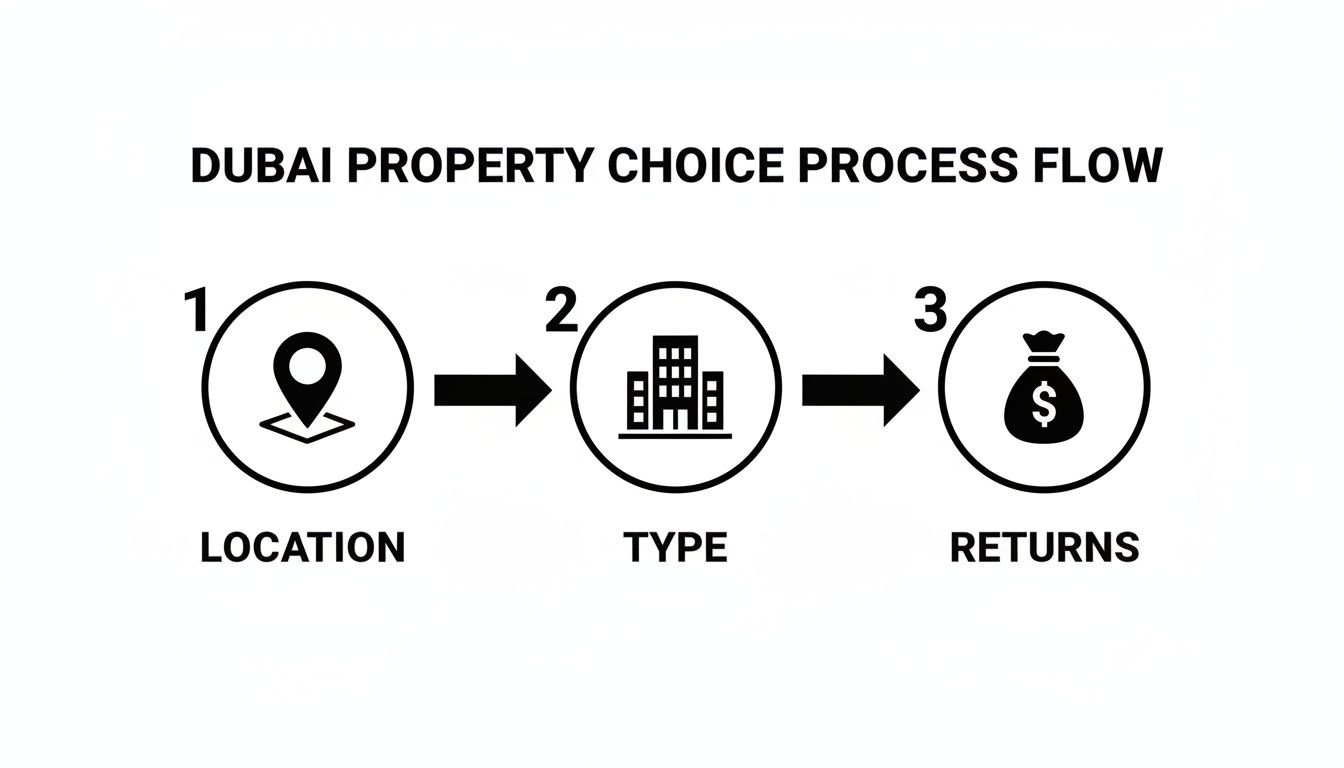
This process highlights how a successful investment starts with aligning the right community with a suitable property type to achieve your financial goals.
The Essential Steps to Ownership
Your journey to holding the keys is a clear, logical sequence. Every stage is deliberately designed to protect both you and the seller. Knowing this path from the get-go means you can move forward with total confidence.
Sign the Agreement for Sale (Form F): Once you’ve found your perfect property, the first official move is signing the Agreement for Sale, known as Form F. This isn't just any contract; it's a standardised RERA document that spells out every term and condition, leaving no room for surprises down the line. It’s the legally binding foundation of your purchase.
Secure a No Objection Certificate (NOC): Next up, the seller needs to get an NOC from the property developer. This is a crucial checkpoint. It’s the developer’s official stamp of approval, confirming that all service charges are paid up and there are no outstanding issues. This simple certificate ensures you’re getting a clean title, free and clear.
Complete the Property Transfer: The final step happens at a DLD-approved registration trustee office. Here, you and the seller (or your legal reps) will sign the final transfer documents. Once all the fees are settled, the DLD issues a brand-new title deed in your name. Just like that, you are the official, registered owner.
Think of the purchase process as building with LEGOs. Each step—the sales agreement, the NOC, the final transfer—is a specific block that must be clicked perfectly into place before the next one can be added. The DLD and RERA provide the instruction manual, ensuring your final creation is strong, stable, and completely secure.
Understanding the Financials
Beyond the asking price, it's essential to factor in the associated costs. These are standard fees for every transaction in Dubai, and knowing them upfront makes for much smoother financial planning.
Here’s a quick breakdown of what to expect:
DLD Transfer Fee: This is the big one, set at 4% of the property's purchase price.
Registration Trustee Fees: These are administrative costs for the office handling the transfer, typically around AED 4,000.
Agent Commission: The standard real estate agent’s fee is 2% of the sale price.
Developer’s NOC Fee: A fee paid to the developer for issuing the NOC, which can range from AED 500 to AED 5,000.
For international investors, financing is readily available from a host of local and international banks. Non-residents can generally secure mortgages for up to 50% of the property's value, though the exact terms will vary. It’s always a smart move to work with a mortgage advisor who can shop around and find the best rates for you.
Finally, before you sign on the dotted line, get the full picture. Understanding the complete process, including learning more from an expert guide on property inspection costs in Dubai, ensures there are absolutely no surprises. This proactive approach is the hallmark of a savvy investor.
Analysing Future Market Trends and Projections
To truly invest with vision in Middle East real estate Dubai, you have to look beyond today’s headlines and start anticipating tomorrow's opportunities. The market isn't a static snapshot; it's a living, breathing story of incredible growth, resilience, and pure ambition. Honestly, learning to read the signs is what separates a good investor from a great one.
Think of it like checking the weather forecast before you set sail. Key performance indicators (KPIs) like price per square foot, rental yields, and transaction volumes are your forecasting tools. They reveal the underlying currents of the market, giving you a sense of where things are headed long before the crowd catches on.
And the story these indicators are telling right now is one of remarkable strength. Even with all the uncertainty in global markets, Dubai just keeps proving itself as a world-class destination for investment.
Reading the Data Behind the Headlines
Numbers have a way of cutting through the noise, and the recent performance of Dubai's property sector speaks volumes about its momentum. The data paints a crystal-clear picture of a market buzzing with demand, fuelled by both investor confidence and a growing population.
This table gives a quick, at-a-glance summary of the incredible growth we've been seeing in the residential market.
Recent Dubai Real Estate Market Performance
Metric | Performance Figure | Time Period | Year-on-Year Change |
|---|---|---|---|
Residential Sales Transactions | 94,000 | First Half of Year | +23.04% |
Total Transaction Value | AED 262.7 billion (USD 71.5 billion) | First Half of Year | +37.68% |
Residential Price Index Growth | 15.60% | Annual | N/A |
Apartment Price Growth | 15.22% | Annual | N/A |
Villa Price Growth | 17.81% | Annual | N/A |
As you can see, the robust demand has naturally pushed property values up across the board, with villas showing particularly impressive gains. This isn't just a fleeting trend; it’s a sign of a fundamentally strong and confident market. To gain a deeper understanding of potential market shifts and make data-driven decisions, exploring resources on how to leverage predictive analytics in real estate investment can be incredibly valuable.
Dubai's Economic Agenda D33: A Vision for the Future
Looking even further down the road, Dubai's entire trajectory is guided by its ambitious Economic Agenda, known as 'D33'. This isn't just some government plan; it's a bold roadmap to double the size of the city's economy and cement its status as one of the top three global cities by 2033. For the real estate sector, the implications are massive.
Investing in Dubai today is like buying stock in a company that has publicly committed to doubling its revenue, backed by a flawless track record of achieving its goals. The D33 agenda is the city's business plan, and real estate is a primary beneficiary.
This agenda is already shaping the future, and we’re seeing several key trends emerge as a direct result of this forward-thinking strategy. These are the areas where visionary investors will find their greatest opportunities.
Sustainable Development: Green building standards and eco-friendly communities are no longer a niche—they're a priority. This appeals directly to a new generation of environmentally conscious residents and investors.
The Rise of Branded Residences: Partnerships between luxury brands and developers are creating ultra-premium properties that offer unmatched service and prestige, which naturally command higher returns.
Integration of Smart Technology: From smart home automation to AI-driven building management, technology is making life better and adding tangible value to properties.
Understanding these future-focused trends is absolutely essential. By aligning your investment strategy with Dubai's long-term vision, you're not just buying a property; you're securing a stake in a city that is meticulously planning for decades of prosperity. For more details on what's next, check out our article exploring the Dubai real estate outlook for 2024 and beyond. This kind of perspective ensures your investment is built on a foundation of smart, sustainable growth.
Your Dubai Real Estate Questions Answered
Stepping into a new investment landscape, especially one as dynamic as Dubai's, naturally brings up a few questions. When you're considering a move in middle east real estate dubai, getting clear, direct answers is the only way to build the confidence you need to act. That's exactly what this section is for—tackling the most common queries from international investors just like you.
Think of this as a conversation with a trusted advisor. We've gathered the essential questions and provided straightforward answers to cut right through the noise. Our goal is simple: to replace any lingering uncertainty with the clarity you need to make your next move a truly informed one.
Can Foreigners Buy Property Anywhere in Dubai?
This is usually the first question on every international investor's mind, and the answer is refreshingly straightforward. While you can't buy property just anywhere, the areas open to you are precisely the ones you’d want to invest in anyway.
Foreign nationals can purchase property on a freehold basis in specially designated zones. That term, freehold, is key. It means you gain full, outright ownership of both the property and the land it sits on, with your name officially registered at the Dubai Land Department. It's yours, period.
And these freehold areas aren't just random spots on a map; they are Dubai's most globally recognised and sought-after communities. We're talking about iconic districts like:
Downtown Dubai
Dubai Marina
Palm Jumeirah
Jumeirah Lakes Towers (JLT)
Business Bay
This strategic approach welcomes global capital into the most attractive parts of the market while keeping other areas for locals. The best advice? Always work with a RERA-certified professional. They can instantly confirm a property's freehold status, ensuring your investment is secure right from the start.
What Are the Main Costs Besides the Property Price?
A smart investor always looks at the total cost, not just the sticker price. Thankfully, Dubai's associated fees are transparent and well-defined, which makes planning your finances much easier. Think of these as the final steps that lock in your ownership.
The biggest line item is the Dubai Land Department (DLD) transfer fee, which is a flat 4% of the property's value. This is the main government charge for officially registering the sale in your name.
Beyond that, you should budget for a few other standard costs. A real estate agent's commission is typically 2% of the purchase price. If you're getting a mortgage, your bank will have its own processing and property valuation fees.
Finally, you’ll need a No Objection Certificate (NOC) from the developer to confirm there are no outstanding service charges. This comes with a fee that can vary. All in, it’s a good rule of thumb to budget an extra 7-8% on top of the property's purchase price to cover everything.
What Is the Difference Between Off-Plan and Secondary Properties?
Choosing between an off-plan or a secondary property is a strategic decision that really comes down to your investment goals. One path offers the thrill of higher potential growth, while the other provides the security of immediate returns.
Imagine you're investing in a new company. An off-plan property is like buying shares in a promising startup before it goes public. You're buying directly from a developer before the building is even finished, often securing a lower price and more flexible payment terms. This can lead to fantastic capital appreciation by the time you get the keys, but it does mean waiting for the project to be completed.
A secondary market property, on the other hand, is like buying shares in an established blue-chip company. It’s an existing home being sold by its current owner. The huge advantages here are certainty and speed; you can physically walk through the unit and start earning rental income almost immediately. These properties reflect current market values and usually require a larger upfront payment.
Is Real Estate Tokenization a Reality in Dubai?
Absolutely, and it’s one of the things positioning Dubai at the very forefront of property innovation. Real estate tokenization is simply the process of converting ownership rights in a property into digital tokens on a blockchain. Each token represents a tiny fraction of that property's value.
In March 2025, the Dubai Land Department (DLD) launched a pilot project for this, becoming the first land registry in the Middle East to implement blockchain-based property tokenization. This single initiative is projected to create a market worth AED 60 billion by 2033.
This completely changes the game by making real estate investment more accessible than ever. Instead of needing hundreds of thousands of dollars to get in, investors can buy fractional ownership with a much smaller amount of capital. It also brings incredible liquidity to the market, as these digital tokens can be traded far more easily than a physical building. It's a powerful signal of the city's commitment to building a more transparent, efficient, and globally accessible real estate market for the future.
At Credence & Co., we provide the clarity and precision you need to make confident investment decisions. Our RERA-accredited valuation experts offer unbiased, technically robust reports that de-risk your transactions and optimise outcomes. Whether you are acquiring, financing, or developing property in the UAE, our team is here to support you with market-leading insights. Learn more about our specialised real estate valuation services.


Comments